
Yoga Studio Name Ideas: How to Choose a Name That Attracts the Right Members


Get the monthly playbook digest
Unsubscribe any time.
Before you’ve hung a mat rack or taught a single class, your yoga studio name is already at work. It’s what shows up in a Google search, what goes on the sign, what someone types into Instagram to check you out.
Naming a fitness studio is the first real brand decision you’ll make, before the logo, before the website, before the first ad. Get it right, and you might get surprised at the impact of the real choice for your business.
So how do you choose a yoga studio name? Start with three things: the audience you want to attract, the feeling you want people to have before they walk in, and a domain you can actually secure.
Read More: How to Start a Yoga Business: A Practical Guide for Studio Owners
Your name sets expectations before anyone sees the space or takes a class.
Someone searching “yoga near me” judges your studio by its name and profile alone, before they ever see a photo. Calm and restorative attracts a type of yogi while high-energy and athletic attracts another.
That first read carries real weight: businesses with a complete, accurate Google business profile are 70% more likely to get a visit and 50% more likely to be considered for a purchase, according to Google’s own data.
And with 97% of consumers reading reviews before choosing a local business, the name attached to those reviews is doing more work than most owners realize.
That first impression becomes the foundation for everything else: your yoga brand identity, your marketing materials, your domain.
It’s worth getting right the first time: McKinsey’s research on design-led companies found they post 32% higher revenue growth than their peers, and that starts with foundational decisions like a name.
The flip side is expensive: a small business rebrand typically runs $15,000 to $75,000+ and takes about seven months, and close to 40% of rebrands fail to deliver a positive return within two years because the name change wasn’t backed by real strategy.
Studios that treat yoga studio branding seriously from day one skip that costly do-over entirely.
There’s also a real search cost to a name that blurs with a nearby studio. Nearly half of all Google searches — 46% — have local intent, and per Whitespark’s annual local ranking factors research, the keywords in your business title are one of the top three factors deciding whether you show up in Google’s local map pack at all.
Check Out: 7 Steps to Creating the Perfect Gym Name
Here’s each one, with real examples you can build on, and the same four directions work for Pilates studio name ideas and other boutique studio names too, if that’s the boat you’re in.
This direction leads with calm, breath, and stillness instead of performance, a natural fit for restorative, yin, or meditation-focused studios. It usually works by pairing a stillness word with a simple studio term:
The pattern holds because it sets the right expectation before anyone walks in, nobody shows up to Stillpoint expecting a 100-degree power class.
This direction leads with movement, heat, and flow, built for power, vinyasa, or hot yoga studios that want the name to signal intensity.
Think:
What works best here are action verbs and heat words. This direction has room to grow, with demand for higher-intensity, results-driven yoga formats climbing, so a name that signals intensity up front is doing real positioning work, not just sounding cool.
This direction anchors the name to a neighborhood, landmark, or city: Riverside Yoga, Fifth & Main Yoga, Cedar Park Yoga, Harbor District Yoga, [Your City] Flow Collective, just to put a few examples.
Beyond the obvious community appeal, this direction pulls double duty on search. Since the keywords in your business title directly influence whether you show up in Google’s local map pack, a name that includes your neighborhood is quietly doing SEO work every time someone searches “yoga near [neighborhood].”
Short, easy to say, and simple to build a brand around:
There’s real research behind why this direction performs well beyond aesthetics. A 2023 study published in PLOS One found that companies with names that are easier to say and process are perceived as more trustworthy. They also see stronger investor and consumer response than companies with harder-to-process names.
The same fluency effect that makes “Google” easier to trust than a ten-syllable alternative applies to a yoga studio name showing up in a Google search or an Instagram bio. Simpler reads as more credible, faster!
Read more: Yoga Studio Software: A Complete Guide
There are plenty of yoga studio name generator tools that can help you generate even more names based on the details you decide to share with them. We’ve compiled a list of the best available:
Got the name locked in? Now systemize the studio: download our free Pilates Studio Toolkit and get 5 ready-to-use playbooks in minutes.
Two ABC Glofox customers show how these directions play out in practice.
Baraza Yoga is a concept-led name. Founder Alex Du Toit moved to Lisbon in 2018 and felt the yoga community she’d loved in Cape Town was missing from her new city, so she opened her own studio in May 2019 to rebuild it.
“Baraza” is a Swahili word for a communal meeting place, a porch or gathering spot where people come together to talk and connect. That’s exactly what she set out to recreate, and five years later the studio has grown to around 1,000 active members.
The name works because it captures the feeling she was chasing before a single class was ever taught.
YogaFit Studios is an audience-led name. CEO and owner Ashok Dhariwal runs a multi-location studio group, and the name tells a prospective member exactly what to expect before they click anything: yoga, framed as fitness.
That clarity mattered when the business needed to scale safely and fast: self-serve booking and check-in “saved our business during COVID-19,” in Ashok’s words, letting members manage their own classes across locations with zero added friction.
A descriptive, no-mystery name makes it easier to expand into new neighborhoods, because members already know what they’re walking into.
Check Out: The Yoga Studio Playbook for 2026: Trends That Actually Matter
Are you building for beginners easing into a first practice, or experienced students who want an intense vinyasa flow?
Style, pace, and life stage should all point toward the same kind of name. A name built for busy parents squeezing in a lunchtime class reads differently than one built for competitive athletes cross-training.
Search “yoga studio [your neighborhood]” and see what comes up. If your shortlist sounds like it could be confused with an existing studio down the street, cross it off.
That overlap costs you in search rankings and in word of mouth, as covered above.
Revisit the four directions above: zen, energetic, local, or minimalist, and pick the one that matches the experience you’re building, not just the one you personally like best.
Most owners stop after 5-6 names. Push past that; the strongest option is often the 15th idea, not the 3rd. More on that below.
If it’s hard to say clearly on a phone call or awkward to shout across a waiting room, that’s a real problem, not a small one.
Simpler, easier-to-pronounce names consistently read as more trustworthy, the same effect covered in the section above.
People close to you will be encouraging by default. Someone who fits your actual ideal student profile will tell you if a name is confusing or off-putting.
Check your state or country’s business name registry, search trademark databases, and lock down the domain and main social handles together.
A great name with no available domain creates problems you’ll be solving for years.
Once you’ve worked through the steps above, this prompt turns your answers into a longer, sharper shortlist. It works in Claude or ChatGPT, and gets noticeably better the more specific your inputs are:
I’m naming a yoga studio. Here’s what you need to know:
Generate 15 yoga studio name ideas that fit this brief. For each name, add one line explaining why it fits. Avoid names that are hard to pronounce out loud or longer than three syllables. |
Run it three or four times, tweaking one input each round (try a different feeling, or a shorter founding story), and pull your favorites from each batch into one shortlist before moving to step 6 above.
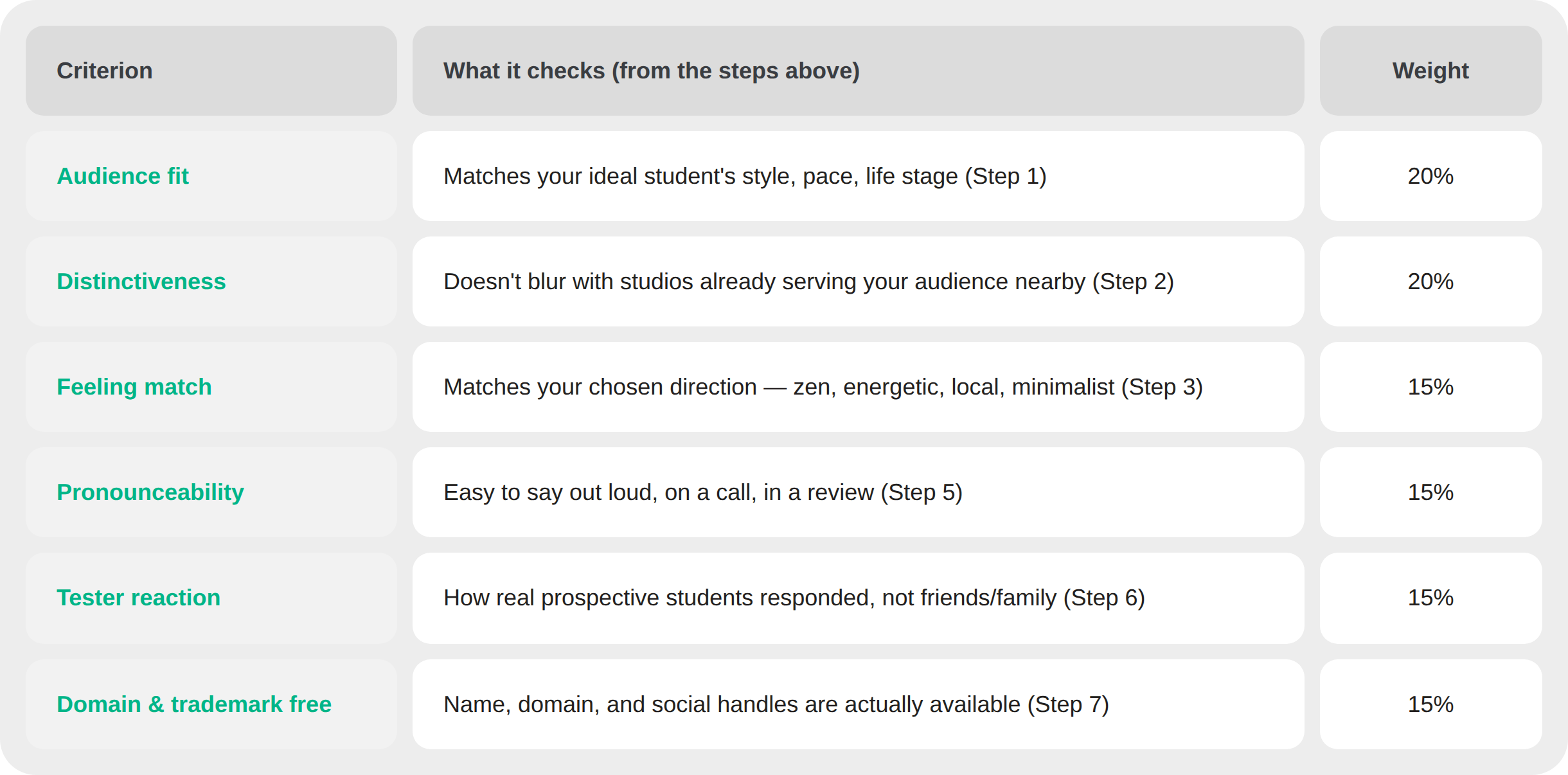
Once you’ve expanded your list with the AI prompt above and tested a few finalists, drop your top candidates into this matrix. Score each one 1 (weak) to 5 (strong) per criterion, multiply by the weight, and add across the row; the highest total wins. As an example:
Example, scored against three finalists from the styles above:
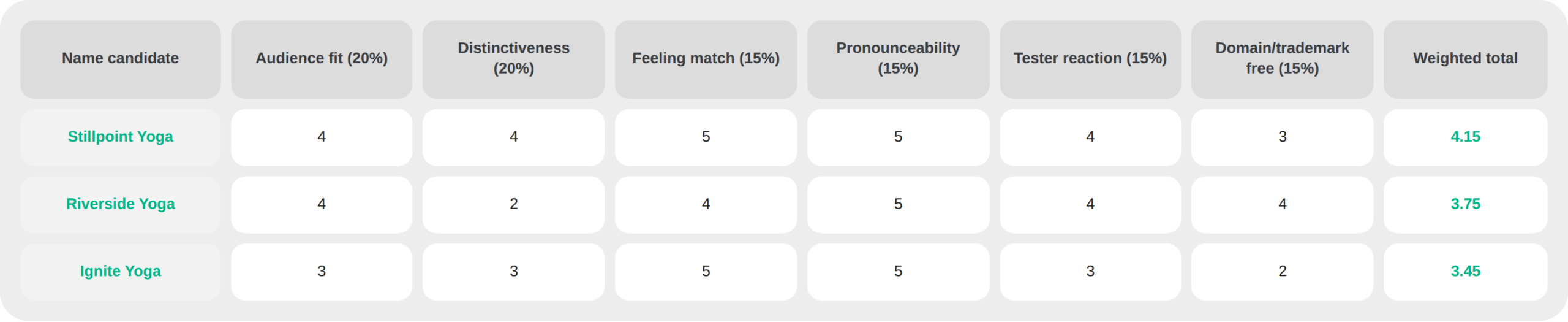
Stillpoint wins here even though it didn’t top every column, because it’s strong where the weights matter most (audience fit and distinctiveness carry the most weight). Swap in your own finalists and scores; the point of the matrix is to stop you from picking the name you personally like best over the one that actually tests well.
The core fitness studio naming tips apply here: start with your ideal student and the feeling you want them to have before they walk in, whether that’s zen, energetic, local, or minimalist. Build a shortlist with an AI prompt, say each option out loud, test it with real prospective students, and confirm the name and domain are both free before you commit.
Either can work, but the deciding factor is your specific audience, not a rule. Sanskrit or other non-English terms (like Baraza Yoga, above) can signal authenticity and depth for students already familiar with yoga tradition, but they carry real risk if your audience is beginners who may mispronounce or misunderstand the word. When in doubt, test the name with people who match your actual student base, not just yoga insiders.
Search your state or country’s business registry, run a trademark search, and check domain and social handle availability, all in the same sitting, so you’re not stuck loving a name you can’t actually use.
Short, easy to pronounce, and tied to a single clear feeling. Names that try to communicate everything about the studio at once are the hardest ones for people to remember and repeat.
A great name is the first brand decision you’ll make, but it’s not the last one. Once your name, domain, and social handles are locked in, the real work starts: building a studio that actually delivers on the promise that name makes to a first-time visitor.
That’s where the right systems matter as much as the right name. Baraza Yoga and YogaFit Studios, above, didn’t just land on a name that fit their vision, they backed it with software that could handle bookings, payments, and member check-in without the pen-and-paper struggles that hold a lot of new studios back.
See how ABC Glofox helps yoga studios run day-to-day: scheduling, payments, and a branded member app built specifically for yoga and boutique fitness businesses, so your name isn’t the only thing that feels professional from day one.
For a deeper, step-by-step plan once your studio is open, grab A Growth Playbook for Yoga Studios, or read up on creating an effective fitness culture to make sure the community inside the studio lives up to the name on the door.
Ready to see it in action? Get a free demo and find out how ABC Glofox can support your studio from opening day onward.