

TL;DR: Starting a fitness studio means navigating startup costs, legal setup, equipment, staffing, and marketing before you even open the doors. This guide will help you move from big idea to grand opening with confidence.
Valued at about US $46 billion in 2025, the boutique fitness industry is on track to reach around US $80 billion by 2034, growing at a steady rate of roughly 7% per year.
This growth has pushed traditional gyms to redesign their offerings to mimic the boutique model, adding small-group training zones, curated lighting and music, and a strong emphasis on community vibes.
Boutique studios offer what big boxes often don’t: specialization, personalization, and an engaged community. They offer a sense of belonging alongside being a great place to work out.
Of course, launching a boutique studio comes with its challenges. But with the right plan, passion, and partners, you can build a thriving business that truly makes an impact in your community!
If you’re wondering how to start a gym business, you’re in the right place. This step-by-step guide is designed to show you exactly how to open a boutique fitness studio, from concept to launch. Let’s get started.
Step 1: Define Your Boutique Studio Concept and Niche
The fastest-growing boutique fitness categories include:
- Yoga, Pilates, and Barre
- HIIT and Cycling
- Cross Training and Boot Camps
- Boxing and Martial Arts
- Sport Performance Training
For starters, Pilates and yoga studios are expanding rapidly but are also among the most saturated segments. So while there’s plenty of opportunity for innovation, it’s vital to carve a unique angle or hybrid experience.
Will your focus be on reformer Pilates, HIIT, cycling, or strength-based small-group sessions? Studios with a clear, specialized identity tend to build loyalty faster than those that try to offer everything.
Secondly, hone in on your target audience. Demographically, Millennials and Gen Z are driving boutique fitness growth. These are the two generations who prioritize holistic health experiences that combine physical fitness with wellness and community.
Women currently represent the largest share of boutique fitness members (77%), but participation among men is rising fast, especially in hybrid and performance-focused concepts.
Lastly, you need to develop your brand story and vibe. What emotions do you want your space to evoke: energy, calm, empowerment, belonging? What does your community stand for? Think beyond workouts. Successful boutique studios deliver a feeling, not just a fitness plan.
📝 Check out: How to Build a Fitness Community
Step 2: Create a Fitness Business Plan
Once your concept is clear, the next step is turning it into a structured plan. Your fitness business plan defines where you’re going, how you’ll get there, and what it’ll take to make your studio sustainable.
But first, ask yourself: Who is this plan for?
If it’s mainly for you and your team, your business plan acts as an internal blueprint — a reminder of what to focus on, which milestones to hit, and how to move forward as your studio grows. It can be lighter in tone, visual, and more goal-oriented than formal.
If it’s meant for investors, banks, or crowdfunding platforms, or if you’ll use it for administrative or tax purposes, it should follow a more traditional format. That means clearly defined sections, detailed forecasts, and professional language that communicates how to start a gym business with credibility and stability.
In either case, your plan should cover these essentials:
- Executive summary: A one-page overview of your concept, target audience, and brand positioning. Clearly explain your niche, mission, and what differentiates your studio.
- Market analysis: Research your local fitness landscape. Identify direct competitors, target demographics, and trends in your community. For instance, boutique studios in wellness-oriented neighborhoods tend to perform better due to higher engagement and income levels.
- Services and pricing model: Outline your offerings, from small-group classes and private training to online or hybrid memberships (more on this below).
- Marketing and sales strategy: Define how you’ll attract, convert, and retain members. This includes pre-launch buzz, partnerships, referral programs, and digital marketing strategies.
- Financial plan and KPIs: List the main studio startup costs, projected revenue, and break-even point. Establish key performance indicators (KPIs) such as member retention rate, class utilization, and monthly recurring revenue.
📝 Free Resource: Fitness Business Plan Template
Pricing mode: how boutique studios make money
Memberships are the main way that studios make money.
However, studios that build sustainable margins don’t stop there! Before you open, it’s worth mapping out which revenue streams fit your model — and to include this information in your business plan.
- Membership fees. Your core recurring revenue. Pricing varies widely by concept. Premium or specialist facilities can command $100+/month or more when the programming and community justify it. You could offer unlimited memberships for committed clients; class packs or credits for flexibility; or hybrid memberships combining in-studio and digital training options.
- Group classes and specialty programming. This is a scalable and community-building option. A single instructor leading a full class generates more revenue per hour than one-on-one training and gives members a reason to show up on a schedule.
- Private training. Whether you’re the trainer or employing staff, personal training sessions allow you to charge above the flat membership rate and build lasting relationships.
- Retail and merchandise. Branded apparel, water bottles, supplements, and studio merchandise all add margin-positive revenue with minimal overhead. Retail products also double as brand-building every time a member wears your logo outside your space.
- Facility rentals and events. Renting your space for competitions, pop-ups, or corporate wellness sessions during off-peak hours turns dead floor time into income.
📝 Read More: How to Make a Gym Profitable: 7 Smart Strategies for Sustainable Growth
Step 3: Secure Funding and Budget for Gym Startup Costs
One of the biggest questions people have when starting a fitness studio is, “How much is this going to cost?”
Studio and gym startup costs vary depending on the size, location, and type of facility you’re opening. It doesn’t matter whether you’re starting a boutique personal training studio or have Equinox-level aspirations — either way, you’ll need a clear picture of the finances.
The table below estimates costs for a 1,500 sq ft boutique studio in the US. The low end reflects a lower cost-of-living market (e.g., a mid-sized Midwest or Southern city); the high end reflects a major metro area (e.g., New York, Los Angeles, Chicago).
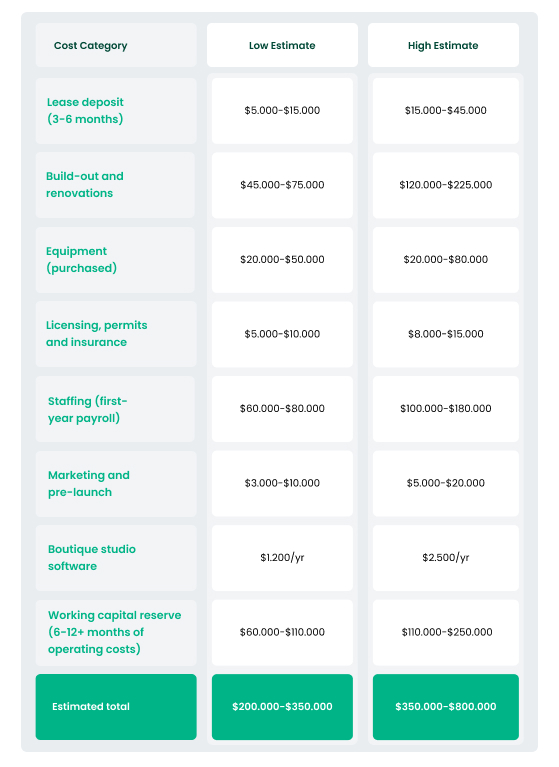
Concepts like Pilates demand higher upfront costs due to specialized reformer equipment, while more flexible formats such as yoga require less capital and smaller spaces. Starting in a secondary neighborhood or shared facility helps lower initial risk and offers room to grow.
A few notes on cost ranges
- Lease deposit is based on 1,500 sq ft at $15-$20/sq ft annually in LCOL markets, rising to $40-$60/sq ft in major metros. Finding a space previously built out for fitness (with flooring, mirrors, or HVAC already in place) can help you save on build-out costs.
- Build-out is the most variable line item and the one most influenced by location. A LCOL studio with minimal structural changes can come in well under $75,000. A HCOL studio in a raw commercial space requiring new HVAC, plumbing, acoustic treatment, premium finishes, etc. can push past $200,000. Negotiating a strong tenant improvement allowance (TIA) from your landlord is the single most effective way to reduce this cost.
- Equipment costs are relatively consistent across markets since you’re typically buying from national suppliers. The range reflects concept type: a yoga studio needs less equipment than a HIIT or Pilates studio. A boutique studio opening with a focused, intentional equipment set can come in toward the low end. Quality used equipment is a budget-friendly option.
- Staffing is where HCOL markets hit hardest after rent. Staff wages in cities like New York, Los Angeles, or San Francisco run significantly higher than in mid-sized markets. Budget for at least one additional team member beyond yourself as relying on a single instructor creates coverage risk from day one.
- Working capital needs to cover 6-12+ months of operating costs while you build membership. This is the figure most first-time studio owners underestimate. A strong pre-launch membership campaign can shorten that runway considerably, but plan conservatively.
If you’re opening a larger boutique concept (2,000-3,000 sq ft), push costs toward or beyond the high end of each range.
Monthly operating costs and break-even point
The primary gym startup costs include:
- Lease/rent
- Renovations/build-out
- Staff and training
- Utilities
- Insurance and legal
- Marketing and sales
- Fitness studio software
- Maintenance/repairs
- Cleaning supplies
Each of these varies based on your concept. Investing in a prime area with upscale design and branding increases expenses but can elevate your studio’s reputation and revenue potential.
To assist your planning, it helps to map out your fixed monthly costs against your revenue targets. So, for example, if your monthly overhead is $20,000 and your average membership is $100/month, you need roughly 200 paying members to break even. This number should shape your pre-launch sales targets.
Many gyms take 6-12+ months to reach break-even, assuming strong pre-launch marketing and realistic pricing. Build working capital to cover that runway into your plan before you sign a lease.
📝 Read More: How to Create Financial Projections for a Gym
Easily overlooked gym startup costs
Build-out and renovations consistently catch first-time owners off guard.
Acoustic treatment, specialized flooring for different studio zones, custom lighting, and HVAC upgrades for high-intensity classes all add up quickly. Boutique concepts with no plumbing requirements and minimal structural work face a much smaller bill. Studios adding showers, sauna, or recovery amenities face a considerably higher one.
When it comes to studio opening costs, franchising is another path to consider. While the initial investment is typically higher, franchises save you on branding, equipment sourcing, and site selection — and you get a proven business model and operational support from day one.
📝 Check Out: Top Fitness Franchises to Own in 2026
Common funding options for boutique fitness studios
Wondering how to start a gym business? Whether you’re planning to open a boutique gym focused on HIIT, Pilates, or yoga, your funding plan should match your concept’s scale and positioning.
Here are some of the most common funding options for would-be studio owners:
- Personal savings. This is one of the lowest barrier funding options, plus there’s no repayment pressure. However, personal savings can limit your growth depending on your goals.
- Bank loans. The more traditional route, which requires solid personal credit and a business plan. Stricter repayment terms.
- SBA loans. These are government-backed loans with lower interest rates and longer repayment terms than conventional loans. Worth exploring early in the process.
- Crowdfunding or pre-sale memberships to test demand and raise early capital.
- Local grants or wellness programs for community-based support.
- Equipment financing or leasing. Instead of buying equipment outright, financing or leasing it can reduce upfront costs significantly. Many commercial suppliers offer this directly, and it’s a widely used option for first-time gym owners.
- Investors or partners. Equity financing in exchange for an ownership stake. This route is most relevant for would-be franchisees or those with multi-location plans.
📝 Read More: Everything You Need to Know About Gym Financing
Step 4: Find the Right Location and Studio Space
Your studio’s location is one of the biggest decisions you’ll make. It’ll shape your brand image, member experience, and profitability from day one. The goal is to find a space that aligns with your target members and supports your long-term business model.
Start by identifying where your ideal members live, work, and spend time. Boutique fitness thrives in neighborhoods with strong community ties, high walkability, and proximity to coffee shops, wellness centers, or co-working spaces.
When touring spaces, consider both visibility and accessibility.
Things to notice: street-level storefronts or spots near busy intersections boost walk-in awareness, while convenient parking and public transit options improve retention.
Beyond location, the layout and design of your studio play a major role in how members feel. You might want to do some research online, consult an interior designer, or peek into your favorite studios to get some inspo, even if it’s from Pinterest.
Space is an element to think about! Open floor plans foster community and energy; smaller zones create intimacy and focus. Natural light, acoustics, and temperature control also impact experience and comfort.
Understanding commercial leases for boutique studios
Lease terms matter more than most first-time studio owners realize. The monthly rent is the headline number, but the terms around it can cost you far more over the life of the lease.
Before you sign, negotiate things like:
- Tenant improvement allowance (TIA). This is money the landlord contributes toward your build-out.. This allowance is often available in a softer commercial market, you just have to ask.
- Initial term and renewal options. 3-5 years is standard, though you’ll want to confirm renewal terms are specified upfront.
- Rent escalation clauses. Understand how and when rent increases so you can update your budget accordingly.
- Early-exit provisions. What does it cost to get out if the business needs to pivot?
Getting these right can save you tens of thousands dollars over the course of your lease.
📝 Read More: Commercial Real Estate for Gyms Explained
Step 5: Choose the Right Equipment and Tech Stack (Hardware & Software)
Build your boutique gym equipment list around your core training style.
Strength and HIIT studios need durable flooring, free weights, racks, and conditioning tools. Pilates requires reformers and balanced spacing for safety and comfort. Yoga and barre studios rely more on atmosphere, mirrors, lighting, and acoustics.
Your software matters, too. Take time to find an all-in-one studio management software that fits your studio’s size and goals.
Features to consider:
- Manage class schedules and bookings in real time
- Automate payments, renewals, and attendance tracking
- Streamline onboarding and digital waivers for new members
- Access reporting and retention insights to optimize performance
- Offer a branded member app that keeps members connected and engaged
Step 6: Register Your Business and Get Licensed
Before opening your doors, make sure your business is legally sound. This step isn’t glamorous, but it protects you, your team, and your members while building trust with landlords, banks, and future partners.
Start by registering your business according to local regulations. Most boutique fitness studios operate as LLCs or limited companies, which separates your personal assets from the business. You’ll also need a business tax ID and to register for any local or state taxes required in your area.
Permits and licenses
These vary by state and city, but most studios need:
- Business license
- Certificate of occupancy (proves your space is safe and meets building codes)
- Zoning and land use approval
- Health club registration (required in some states; check your state’s consumer protection office)
- Sales tax permit (if selling retail products or taxable services)
- Fire safety and health inspections
- Signage permit
- Music license
Start this process early. Permit timelines can run weeks to months depending on your municipality. SBA.gov has a state-by-state guide.
Insurance
You can’t open a gym without having proper insurance in place. Each policy covers a different type of risk exposure:
- General liability: injuries on your premises (mandatory; most landlords require proof before you take possession)
- Professional liability: trainer errors, omissions, or negligence claims
- Commercial property: equipment, improvements, and contents
- Workers’ compensation: legally required in most states the moment you hire staff
A broker who specializes in fitness businesses can bundle these policies efficiently and make sure there are no gaps.
📝 Read More: Gym Insurance Explained: The Coverage You Need [2026]
Step 7: Build Your Team and Culture
Your instructors and staff are the heart of your studio. They shape the energy, experience, and community that keep members coming back, often more than the workouts themselves.
Start by hiring for both skill and personality. Technical certifications matter, but emotional intelligence, communication style, and alignment with your brand values matter even more in boutique fitness. Your team should reflect your studio’s mission and help members feel seen, supported, and motivated.
Key roles typically include:
- Instructors or coaches: Certified experts who bring consistency and creativity to each class.
- Front desk or community staff: The first impression of your brand, responsible for bookings, client communication, and retention.
- Studio manager or lead instructor: Oversees scheduling, standards, and daily operations as you grow.
A note on employed vs. contracted instructors
Employed instructors give you more schedule control, consistency, and alignment with your brand. Contracted ones reduce payroll overhead and employer obligations. The right answer depends on your business model, volume, and stage of business.
📝 Read More: How to Assemble the Right Staff Team for Your New Gym
Build a welcoming culture
Once you’ve built your team, focus on culture. Create shared values around accountability, empathy, and excellence. Encourage staff to test new class ideas, collaborate on events, and participate in training.
Culture extends to your members, too. It’s important to build a space that feels like a second home. This includes:
- Greeting members by name
- Keeping locker rooms and equipment clean
- Offering group classes or events to build community
- Responding quickly to feedback or complaints
- Creating a sense of community
Retention starts with relationships, and satisfied members will become your best source of referrals.
📝 Check Out: Beyond Classes: How ABC Glofox Helps You Create a Culture Your Members Love
Step 8: Build Your Marketing and Pre-Launch Plan
You can have the perfect space and a great team, but if no one knows your studio exists, you won’t fill a single class! A smart pre-launch plan builds awareness, excitement, and early memberships before opening day.
- Run a founding member campaign. A limited-time rate for early sign-ups creates urgency and locks in revenue before you open. It also builds the community that makes your space feel alive from day one.
- Build a referral program from the start. Referrals will be the main way you get new members through the doors. And with good reason! Members who come in through a personal recommendation stay longer and cost less to acquire than those who found you through ads.
- Establish a presence on social media. Social media is the highest-return, lowest-cost marketing channel for your studio at this stage. Short-form video, trainer introductions, behind-the-scenes build-out content build genuine interest and buzz.
- Grow your email list before you open. Email is a channel you own outright, which becomes more important as you grow. Offer something valuable in exchange for a sign-up, such as a founding member discount, a free training guide, or early access.
- Build a simple, mobile-friendly website. A simple, clear homepage with your story, services, pricing, and a sign-up widget is enough to start converting visitors. Most members will find you on their phone first, so make sure the site is optimized for mobile.
- Claim your Google Business Profile so local searchers can easily find key business details and get a sense of your business.
- Partner with complementary local businesses. These are businesses where your ideal member already spends money, such as smoothie bars, physios, and nutritionists.
📝 Read More: Gym Marketing in 2026: What’s Working and What’s Not
Step 9: Set Up Memberships, Pricing, and Tech Systems
Once your marketing starts bringing in leads, your next priority is building a pricing structure that feels simple, fair, and scalable, for both your clients and your operations.
Common pricing models include:
- Credit-based memberships: Clients buy a set number of credits to use across classes, great for flexibility.
- Unlimited memberships: Encourage consistency and loyalty for frequent attendees.
- Hybrid memberships: Combine in-person classes with digital access or on-demand programs to add value and support retention.
After defining your pricing tiers, focus on automation. Efficient systems not only save time but also create a smoother member experience.
Automate tasks like onboarding emails, renewal reminders, attendance tracking, and engagement messages to keep communication consistent and personalized.
📝 Read More: The Ultimate Member Engagement Guide
Step 10: Launch and Optimize
By this point in our “how to open a boutique fitness studio,” you’ve built your foundation, your space, systems, and structure are ready for launch!
Many new studio owners get caught up in logistics and keep pushing their opening date “just one more week.”
But launch day deserves celebration. It’s the moment your idea becomes real, your brand meets its first members, and your team finally sees the impact of their work.
Start with a soft launch or preview week to practice operations, test your class schedule, and fine-tune your systems. This trial phase helps your team get comfortable and gives you early feedback from members.
Then, plan your grand opening event — think live demos, giveaways, and founding-member offers. Capture content, encourage check-ins, and showcase your unique atmosphere.
After the buzz, focus on optimization. Track attendance, retention, and conversion metrics from day one.
Use ABC Glofox to monitor bookings, payments, and engagement data, helping you understand what’s resonating and where to improve. Adjust your schedule, pricing, or communication based on trends, not guesswork.
FAQs: How to Start a Gym Business
What are typical gym startup costs?
The cost to start a fitness business varies widely depending on size, location, and concept. Starting a fitness studio can cost as little as $50,00starting a fitness studio0, whereas a standard full-service gym might cost $300,000 or more once you factor in lease deposit, build-out, equipment, staffing, and working capital.
What type of gym is cheapest to open?
Group training studios and personal training studios typically have the lowest startup costs, since they require less equipment and a smaller footprint.
Is opening a gym a profitable business in 2026?
It can be, yes. Profitability depends on your pricing model, how well you retain members, how diversified your revenue streams are, and how efficiently you run operations. Studios and gyms that define a clear niche, price accordingly, and control overhead tend to perform best. Operational tools that reduce admin time, like studio management software, can directly improve your margins.
How much money do I need to start a gym?
For a boutique or personal training studio, budget $50,000-$150,000 to get started. For a standard full-service gym, plan for $300,000 or more (and significantly more in a high cost-of-living market). On top of startup costs, you’ll need a working capital reserve to cover 6+ months of operating costs while you build membership, since most fitness businesses take that long to reach break-even. Review your fixed monthly costs against membership revenue targets before you commit to a space.
Do I need a license or permit to start a gym?
Yes. Most studios and gyms require a business license, certificate of occupancy, and general liability insurance at minimum. Depending on your state and city, you may also need zoning approval, fire and health inspections, health club registration, and a signage permit. Check SBA.gov and your local government office for requirements specific to your location.
Power Your Fitness Studio with ABC Glofox
The boutique fitness market continues to expand because people want something more personal, flexible, and community-driven than what traditional gyms offer. That’s what makes this space both competitive and rewarding.
Now that you know how to open a boutique fitness studio, the next step is to put the plan into motion. With ABC Glofox as your studio management software, it’s easy to manage memberships, payments, scheduling, and marketing in one place.
Start your studio the smart way. Book a demo to learn how our platform can power your growth from day one.
Table of contents
- 1. Define Your Boutique Studio Concept and Niche
- 2. Write Your Business Plan
- 3. Secure Funding and Budget for Startup Costs
- 4. Find the Right Location and Studio Space
- 5. Source Equipment and Choose Your Tech Stack
- 6. Register Your Business and Get Licensed
- 7. Build Your Team and Culture
- 8. Build Your Pre-Launch Marketing Plan
- 9. Set Up Memberships, Pricing, and Systems
- 10. Launch and Optimize
- FAQs: How to Start a Gym Business