

Underpricing your fitness studio memberships may bring people through the door, but if those rates cannot support the experience members expect, they may not stay. Overpricing creates the opposite problem: members start questioning whether the experience justifies the cost.
A smart membership pricing strategy does more than set a monthly fee. It creates a sustainable system of clear offers, reliable payments, and reasons for members to remain.
Looking for a broader pricing overview?
Our gym membership pricing guide compares monthly and annual plans, drop-ins, dynamic pricing, upsells, and other revenue models: Gym Pricing: How to Set Rates That Drive Revenue.
This guide goes deeper into running boutique studio memberships: structuring tiers, setting sustainable rates, managingautopay andrecurring billing, preventing payment-related cancellations, and adjusting prices without damaging member retention.
Quick Answer: What’s the Right Pricing Strategy for a Fitness Studio Membership?
For most fitness studios, the best membership pricing strategy is to offer three clear membership options, collect payments automatically, and review your rates once or twice a year.
Keep it simple:
- Offer three options: A lower plan for occasional members, a middle plan for regulars, and a premium plan for frequent visits or added support.
- Make the differences obvious: Show how often members can attend, which classes they can access, and what support is included.
- Cover your costs: Membership fees must pay for instructors, rent, equipment, software, and other expenses while leaving room for profit.
- Keep class packs flexible: Charge more per class than you do within a membership, so regular attendance offers better value.
- Use autopay billing: Collect fees on schedule and automate renewals, payment retries, and card reminders.
- Review your rates: Check costs, attendance, cancellations, and popular plans before making changes.
Read more: Why Fitness-First Software Matters for Growing Studios
The Main Pricing Models for Studio Memberships
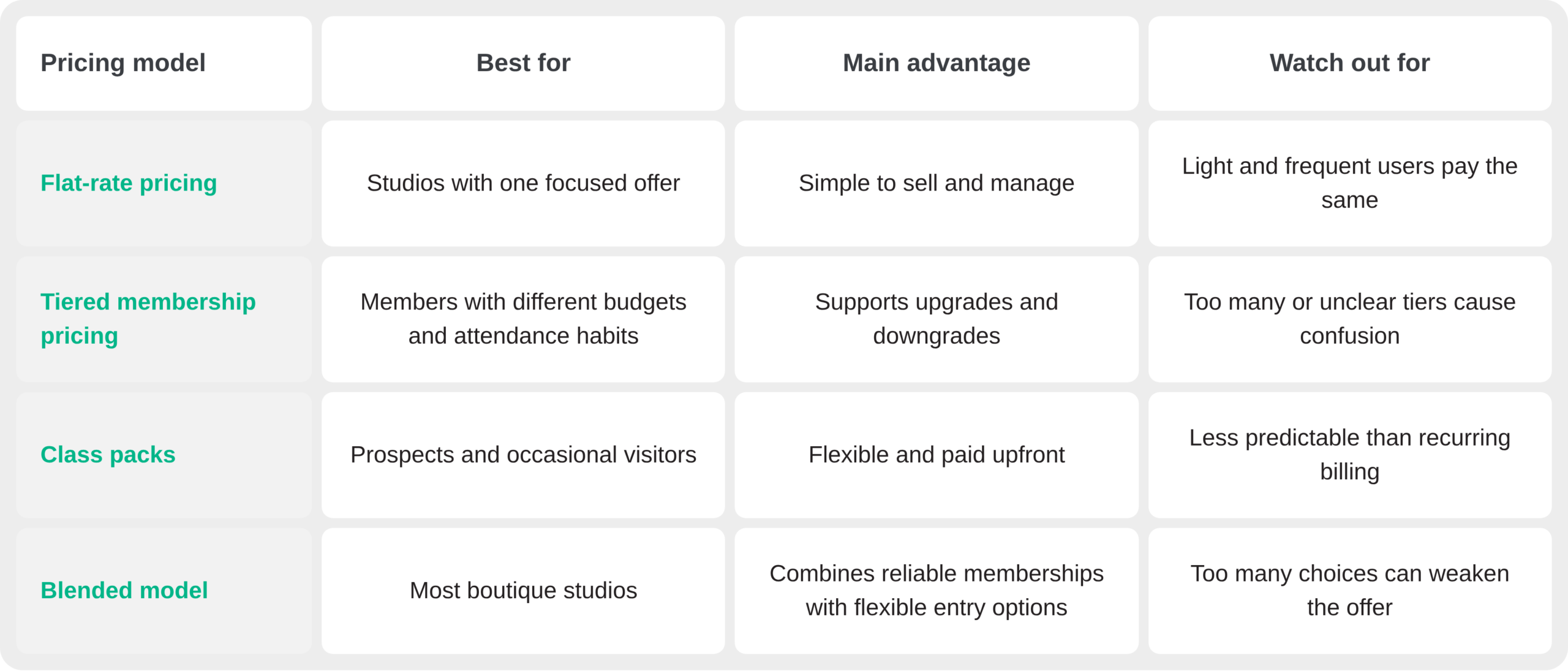
They tend to overcomplicate membership pricing for boutique studios out there. All you need is a simple structure that matches how your members use the studio while generating enough predictable revenue to support the experience. That’s it!
#1 Flat-rate membership
Withflat-rate pricing, every member pays the same recurring fee for the same level of access.
Best for: Studios with a focused offer and members who use the service in similar ways.
Advantages:
- Easy to explain and sell
- Simple to manage
- Gives members one clear decision
Limitations:
- Doesn’t support different levels of willingness to pay
- Light users may feel they are paying too much
- Heavy users may consume more capacity without contributing more revenue, which they’d happily pay for
#2 Tiered memberships
Tiered membership pricing gives members 2-4 options based on factors such as monthly visits, class access, booking privileges, or added support.
Best for: Studios serving members with different schedules, goals, and levels of commitment.
Advantages:
- Accommodates different budgets and usage levels
- Creates a natural upgrade path (winner!)
- Allows members to downgrade instead of cancelling
- Can increase average revenue per member
Limitations:
- Too many options create decision paralysis
- Unclear differences make the higher tiers difficult to justify
- Complicated rules create more work for staff
For most boutique studios, three tiers are enough. The middle option should provide the clearest balance of access, results, and price rather than looking intentionally restricted.
#3 Class packs and punch cards
Class packs allow your fitness studio members to purchase a fixed number of sessions in advance. They work well when individual classes are the main unit of value, as in Pilates, yoga, cycling, and other appointment-led formats.
Best for: New prospects, occasional visitors, and members who cannot commit to a recurring schedule.
Advantages:
- Offers flexibility without discounting individual classes too heavily
- Collects revenue upfront
- Provides an accessible step toward membership
Limitations:
- Produces less predictable revenue than recurring billing
- Creates a natural exit point whenever a pack expires
- Requires renewal prompts to keep the relationship active
Note that class packs should support the membership system rather than compete with it. The per-class price should normally be higher than the equivalent rate inside a recurring membership, giving frequent attendees a clear reason to upgrade.
#4 A blended model
Most boutique studios benefit from a controlled mix, although this might fall into the #2 tiers discussed:
- Recurring tiers provide predictable monthly revenue.
- Class packs serve occasional members and prospects.
- Drop-ins provide a low-commitment first experience.
The goal is not to offer as many choices as possible. It is to give each type of customer a clear entry point while making recurring membership the most attractive option for regular attendees.
Check Out: How Pin Up Pole Studio Increased Revenues by 124% With ABC Glofox
At a Glance: Main Pricing Models for Studio Memberships
Setting Up Autopay and Recurring Billing in a Fitness Studio: Is It Worth It?
Membership payments should be easy for members and require as little work as possible from your team.
Set up autopay when someone joins. Ask them to add their payment details, then show them exactly how much they will pay, when they will be charged, and whether the plan renews automatically.
Good studio software can then collect each payment when it is due and send the receipt automatically. This removes a task your team would otherwise repeat every month.
What happens when a payment fails?
Cards fail for simple reasons. A card may have expired, been replaced, or lacked enough funds on the day of the charge.
That small payment problem can quickly cost you a member. Failed payments drive up to 1 in 3 gym cancellations, even though many of those members never intended to leave.
Your studio management software should be able to:
- Remind members before their cards expire
- Retry a failed payment automatically
- Tell the member if they need to update their details
- Show your team which payments are still overdue
Platforms such as ABC Glofox handle these steps in the background. This gives the payment another chance to go through before someone on your team needs to step in.
A member who leaves because a payment could not be collected is known as involuntary churn. Unlike a normal cancellation, the member may still want to attend. The problem is the payment, not their interest in your studio.
Going beyond basic payment retries
Basic billing tools retry every failed payment in the same way. More advanced systems can use a member’s payment history to choose a better time to try again.
ABC Glofox’s Intelligent Billing is one example. ABC Fitness reports collection rates of up to 98% using AI-supported payment retries and outreach.
Intelligent Billing deals with payment problems. A separate tool, the AI Churn Predictor, looks for changes in attendance and behavior that suggest a member may be losing interest. Together, these tools help studio teams act before a member is lost
Failed payments should not become lost memberships.
See how ABC Glofox can automate recurring payments, recover failed charges, and reduce the billing work passed to your team. BOOK A FREE DEMO
Pricing Benchmarks by Studio Type
There is no single monthly price that works for every fitness business. A 12-person Pilates studio cannot price its memberships in the same way as a gym that can serve hundreds of members at once.
When comparing your rates, look at businesses with a similar class size, service, location, and target member. Their prices can give you a reference point, but your own costs still need to guide the final number. Here are the top three categories based on offerings:
#1 Boutique fitness studios
Boutique means fewer spaces in each class. They may also provide specialist coaching, premium equipment, or more individual attention. This is why boutique studio pricing is often higher per class than pricing at a full-service gym.
Common options include:
- Class packs for occasional visitors
- A membership with a set number of classes each month
- A higher tier for frequent attendance or extra support
For example, a Pilates studio might offer 4, 8, or 12 classes per month. Each higher tier should reduce the price per class, giving regular members a reason to commit.
A signal that you might be underpricing, though, is that your most popular sessions are always full but the studio still struggles to cover its costs.
Free Resource: Pilates Studio Membership Pricing Guide.
#2 Full-service gyms
A typical gym membership pricing structure might include:
- A basic plan for gym access
- A middle plan that includes group classes
- A premium plan with added services or facilities
In this case, a deciding factor in the membership pricing strategy is the number of members that you can realistically attract and retain. Gyms also tend to have a lower retention rate when compared to the other two models here, with one-third of the membership leaving in a year, so you have to account for those who leave and newcomers.
#3 Multi-location fitness businesses
Multi-location businesses need consistency. Members should be able to recognize the same plans and understand the main differences at every site. This is the main reason many people choose franchises compared to single-location gyms in the first place.
So you should keep plan names, core benefits, and tiered membership pricing consistent where possible. Prices may vary when one location has higher costs, different facilities, or a much stronger local market, but those differences should be easy to explain.
If members can visit more than one site, consider offering:
- A lower-priced plan for one home location
- A higher-priced plan that includes every location
The aim is not to force every location into exactly the same price. It is to avoid a different and confusing membership system at each one.
Free Resource: Running Multi-Location Gyms on One Playbook
How Incorrect Pricing Increases Fitness Churn & Mistakes Behind It
Pricing affects how members judge your boutique studio. If the price feels too high for the experience, they start questioning whether the membership is worth keeping. If it is too low, the studio may struggle to maintain its classes, equipment, staff, and service.
A strong membership pricing strategy finds the balance. Members should understand what they are paying for, while the studio earns enough to deliver it consistently. So here’s what to look out for:
- The price does not match the experience: A premium price needs a premium experience. Members will notice when crowded classes, poor communication, or limited support do not match what they pay. It also shows when you’re cutting corners just to get that lower rate.
- Discounts become the normal price: Frequent discounts teach people to wait for the next offer. When the promotion ends, the full membership price suddenly feels expensive.
- Membership options are hard to compare: You will leave a lot of prospects out of your door with this. Be strategic about it.
- Premium pricing works when the value is clear: Members will pay and stay when the coaching, communication, and overall experience support the price
REAL RESULTS FROM AN ABC GLOFOX CUSTOMER
Yes, members will pay more for the right experience
FreshFHIIT’s premium membership costs $200 per month. Monthly churn remains around 3%, while estimated member lifetime value reaches $1,700–$2,000.
5 Steps to Smarter Boutique Studio Membership Pricing
A good membership pricing strategy must cover your costs and still feel worth the price to your members.
1. Add up your monthly costs
Include rent, staff, equipment, insurance, software, payment fees, and marketing. Then consider how many paying members you can realistically serve. Your lowest-priced plan should cover the cost of delivering it and leave room for profit.
2. Compare similar studios
Check what studios with a similar location, class size, audience, and experience charge. Use their prices as a reference, not a number to copy. Their costs and services may be different from yours.
3. Keep your membership options clear
Offer a small number of plans. Differentiate them through:
- How often members can attend
- Which classes they can access
- How early they can book
- What extra support is included
4. Apply fees and discounts consistently
If you charge a joining fee, explain what it covers. If you offer a discount, make its end date and future price clear. Your team should follow the same rules for every member.
5. Review your prices regularly
Check your rates once or twice a year. Look at:
- Which plans people choose
- How full your classes are
- Why members cancel
- Whether your costs have increased
Studio software can bring membership, booking, and revenue reports together so you can see which plans are working. If you raise your prices, tell members in advance and explain the reason clearly.
Comparing 3 Common Pricing Approaches
Most studios use more than one pricing approach. The right membership pricing strategy brings together your costs, the value of your experience, and what your local market will accept.
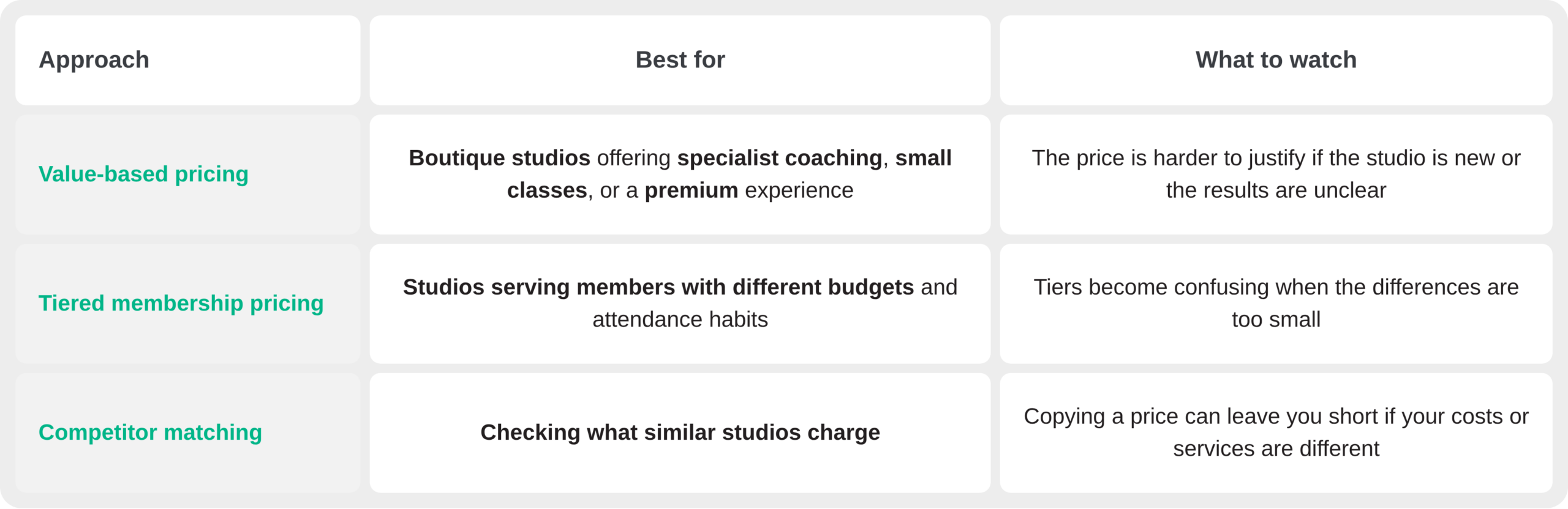
No approach is best for every business. Once your plans are live, track which ones people choose, what each plan earns, and how long members stay.
Read More: The 4 Key Metrics Every Fitness Founder Should Track
FAQs
1. How does membership pricing affect churn?
Members are more likely to cancel when the price does not match the experience. Charging too much makes people question the value. Charging too little can leave the studio unable to maintain its coaching, equipment, and service. Clear plans, reliable billing, and an experience that supports the price all help improve member retention.
2. How do I set up autopay for studio memberships?
Ask members to add their payment details when they join. Show them the amount, payment date, renewal terms, and cancellation policy before they confirm. Use studio software that can collect payments automatically, retry failed charges, and remind members when their cards are about to expire.
3. How often should a studio review its membership pricing?
Review your membership pricing strategy once or twice a year. Check your operating costs, class attendance, cancellations, and which plans members choose. A regular review helps you make small, planned changes instead of waiting until rising costs force a large increase.
4. What is a good pricing benchmark by studio type?
Boutique studios usually charge more per class because they offer fewer spaces and more individual attention. Full-service gyms can often charge less per member because they serve more people. Multi-location studios should keep their plans consistent while allowing for genuine differences in local costs.
Conclusions
Your prices should cover the experience you promise, give members clear choices, and create reliable monthly income. A strong membership pricing strategy brings together simple plans, automatic payments, and regular reviews. Get those pieces right, and pricing becomes a tool for growth, not a reason members leave.
Give your studio best-in-class membership management
Manage plans, automate payments, and track the numbers that drive retention and revenue, all with ABC Glofox.
See ABC Glofox in action– BOOK A DEMO TODAY