AI for Single-Location Boutique Studios: Scheduling, Waitlists, and Member Communication on Autopilot


Get the monthly playbook digest
Unsubscribe any time.
Almost everything written about AI in fitness quietly assumes you have a front desk. This guide starts from what happens when you don’t, when every admin hour comes straight out of the time you’d otherwise spend with members, and that time is the product.
So AI for fitness studios is a different conversation. The most valuable automation isn’t the flashy one everyone talks about, and one cancelled spot in a 12-person class costs more than most owners realize.
Below, you’ll find four things to switch on, ranked by how fast each pays you back, including one most owners skip entirely, plus a real one-founder studio that used them to grow attendance by 110%, without the business feeling any more automated to her members.
This guide is built for the single-location owner-operator: the boutique studio running on 120 to 400 active members, one to three years into the business, still teaching classes yourself. If your week includes chasing no-shows, manually re-opening a cancelled spot, and re-entering the same member’s details across two or three different tools, the three things worth automating first are class scheduling, waitlist management, and member communication — not the enterprise features built for multi-location chains.
Run more than one location, or want the multi-site version of this playbook? See our guide to AI for gyms. We’ve also covered the broader landscape in AI in the fitness industry and ABC Fitness’s wider look at AI in fitness.
Three constraints make artificial intelligence in a fitness studio a different tuning of the same problem: same tools, but scale changes which settings matter, and they all work against you, not for you.
#1 The math of a small class cap
At a 15-person class, one no-show is 7% of that hour’s revenue; two is 13%. An open-floor gym never feels a missing member, you feel every one.
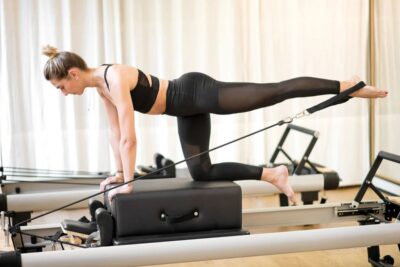
The sharpest version of this math is Pilates: reformer classes typically cap at just 8–12 spots at a higher price point than a group fitness room, so a single late cancel erases a bigger share of that hour’s revenue — and it’s exactly why small capacity makes late cancels costliest here, with complex pack rules the piece most likely to confuse staff trying to backfill the seat fast.
That’s why the highest-value automation in a studio isn’t a chatbot; it’s class waitlist AI: anything that fills a seat within minutes of it opening up.
#1 One of you, three jobs
A bigger gym splits inquiries, marketing, and retention across a front desk, a marketing hire, and a retention specialist.
In a studio, all three land on whoever isn’t teaching right now, the single instructor scheduling problem in a nutshell. AI doesn’t replace those roles for you; it does the queue-work of all three so a team of one or two stays ahead of it.
#3 Retention runs through the instructor, not the app
Every gym runs retention as part system, part relationship, but at studio scale the mix shifts hard toward relationship, because each member is a bigger share of your room and your revenue.
Which flips what a churn alert should do: not fire off a generic email, but tell you, so the follow-up comes from a person who knows them.
Side by side, it looks like this:
Show Image
Same technology, different tuning: at gym scale it absorbs moments no one could handle manually; at studio scale it queues them up for you to handle personally.
If the last section was the “why,” this is the “what.” Four jobs, in the order they’ll pay you back. None of them need a tech team, they’re all switches inside AI gym software you likely already run, not systems you build.
Where ABC Glofox has a feature that does the job, I’ll name it; where a whiteboard does it fine, I’ll say that too.
Start here, because it’s the fastest money. The mechanics are simple, and we’ve covered the general version in our gym automation guide, but at studio scale the stakes change.
When your 6 p.m. reformer class caps at 12 and someone cancels at 4:30, that spot is worth 8% of the class.
The difference between recovering it and eating it is pure speed: an automated waitlist that instantly texts the next person, holds the spot for a short window, then moves down the list. No owner can do that manually from the front of a class they’re teaching.
The same logic applies to the front end of booking.
The AI tools winning in this space consolidate the whole workflow: a prospect clicks a link, books the class, signs the waiver, and pays in one flow, no bouncing between apps, no “someone will get back to you.”
Every step you remove is a lead that doesn’t leak. In ABC Glofox, this is standard plumbing: booking, waitlist, waiver, and payment live in one system, so the automation has everything it needs to close the loop on its own.
Scheduling itself is the other half of this. Recurring class templates, per-modality capacity rules, and instructor-swap notifications are the admin that eats an owner-operator’s week even when every class is full — building the week’s schedule once, having capacity rules hold automatically by modality, and getting notified (not left to discover it at 5:55) when an instructor needs a sub.
Set it up once: waitlist auto-notify on, hold window set (15–30 minutes works for same-day spots), late-cancel window matched to your community’s tolerance. That’s the whole “implementation.”
This is where AI for fitness studios needs the most unpacking, so here’s how the model actually works, in plain terms.
AI churn prediction reads the data already sitting in your booking system: who attends, how often, what they book, and how they pay. It learns each member’s normal routine, and when someone starts drifting from theirs, it labels that member as low, medium, or high risk of cancelling.
You never get to see the math, hence the AI element. You just see a list of names, sorted by who needs attention first.
One missed class means nothing on its own. The model only flags someone when several signals shift at once.
The ABC Glofox’s version, our AI churn predictor, tracks 16+ data points and was trained on booking data from over 41 million members. Because it’s fitness data specifically, it knows a February dip after a January rush is normal, not churn, and that new members are most likely to quit in their first 90 days. How about that?! 😉
The signals it watches are ones you’d recognize yourself, if you had time to watch 150 people at once:
Worth calling out separately for yoga studios: attendance is often teacher-dependent, so a member’s routine can break not because they’re disengaging, but because a favorite instructor’s schedule changed. That’s a different signal than the generic “booking routine breaks” bullet above, and the churn model should treat it differently — a teacher swap, not a warning sign.
At studio scale, these flags show up within days, not after the 30 visit-free days a big gym waits for. By day 30, a studio member isn’t at risk; she’s gone.
In turn, your part takes minutes. Flagged members appear in a Members at Risk report you check between classes, and the alert shouldn’t send anything on its own. It lands with you, as a ready-to-edit message you approve: “Hey Sarah, we missed you on the mat Tuesday. Everything good?”, from a person she knows, while the routine is still warm enough to save.
These flags are only as sharp as the data behind them: retention signals work best when booking, payment, and attendance data live in one system — the same reason a studio running spreadsheets alongside its booking tool gets late or noisy alerts.
Overall, AI spots broken patterns across your whole member list, you automate the communication in a style your members love.
📝 Read More: Fitness Studio Member Retention: How to Keep Members Beyond the First 90 Days — the same 90-day window covered here, broken into a full onboarding-to-community plan.<<
A bigger studio would have a community manager handling onboarding, check-ins, and re-engagement. >>In a single-location studio, that job is manual front-desk work by another name — it belongs to whoever has a spare minute between classes, which means it gets skipped on busy weeks.<<
This is where an AI-enabled fitness CRM takes over: someone writes the messages once, and it sends the right one to the right member at the right moment.
Three sequences cover most of it:
So the sequence starts at sign-up, not at the first visit: a welcome message within minutes of payment, a nudge to book the first class within 48 hours, prep tips before they arrive, and a “how’s it going” from your number around week three, deep in the 90-day window where most new members quit.
Small wins get celebrated too: “second class this week” does more for a nervous beginner than any discount.
Small list, right message, higher hit rate.
Running all of this from one place, from lead follow-up to win-backs, is exactly what ABC XLerate is built for on top of Glofox.
But the principle stands: whatever you run, write the messages yourself, once, in your voice. The automation makes sure they arrive even on the weeks you’re slammed; the words should still sound like they came from the mat.
Check Out: A Q1 2026 Onboarding Playbook for European Gyms & Fitness Studios
The quietest of the four use cases for AI for fitness studios, and the one owners skip. AI revenue tools were built for big gyms selling PT packages. But what the tool actually does is basic: it watches each member’s booking history and spots the moment when a specific offer would make sense for them.
Studios have plenty to offer at those moments: workshops, teacher trainings, class packs, retail. There’s a bonus, too. Members who buy more than just classes stay about three times longer, so every well-timed offer also improves retention.
Here are the five moments the AI catches, and what each looks like in your studio:
Notice the pattern: every offer is small and obvious once you see the moment. The AI’s only job is catching that moment, which is exactly what a busy owner misses. We’ve gone deeper on pricing in how to increase gym revenue; the studio version is the same playbook with smaller, warmer offers.
Natural Measures Cycling is a boutique indoor cycling studio in Indianapolis with one founder, Vikki Gladney. Her days are built around teaching choreographed, beat-driven rides. Admin has to fit around that.
Her setup is the one this article has been describing. Bookings, memberships, payments, and member data all run through ABC Glofox, so the routine work happens without her: spots that open up get refilled from the waitlist, new members book and pay in one flow, and member insights show her who’s coming, who’s slipping, and what’s selling.
Since moving to this setup, class attendance is up 110%.
“ABC Glofox is an investment that helps me to stand out.”
The day-to-day side runs through the ABC Glofox Pro App on her phone, which covers what a front desk would:
For a team of one or two, this is the whole picture: the platform handles the background work, and the phone handles the in-person moments.
The technology is the same; the difference is degree and configuration. Gyms tune AI for volume: inquiry handling, staff scheduling, mass communications. A single-location studio tunes the same underlying features against three specific problems — manual front-desk work, waitlist and no-show leakage, and disconnected tools — because at studio scale, each member is a bigger share of the room and the revenue. The practical difference shows up in setup: studio automations should flag you for personal follow-up rather than send generic messages on your behalf.<<
The technology is the same across modalities, but the signal worth watching shifts. In a Pilates studio, the sharpest costs sit around reformer capacity: an 8–12 spot class carries a heavier per-cancel cost, so waitlist speed and clear pack rules matter most. In a yoga studio, attendance often tracks a specific teacher, so a churn model needs to separate “this member is drifting” from “their favorite instructor’s schedule changed.” Same automation, tuned to a different variable.<<
No. The artificial intelligence that matters for a fitness studio, namely waitlist automation, churn flags, message sequences, offer timing, ships inside studio management platforms as settings, not systems you build. If you can set up a class schedule, you can switch these on. The real work isn’t technical; it’s writing your automated messages once, in your own voice.
Speed. When someone cancels out of a 12-person class, automated waitlist notifications text the next person within seconds, hold the spot briefly, and move down the list until it’s filled, all while you’re teaching. At small class sizes, where one empty spot is 8–10% of the room, recovering cancellations automatically is usually the fastest payback of any AI feature.
Yes, that’s the strongest case for it. Automated welcome sequences, booking-routine nudges, and targeted re-engagement do the queue-work a bigger studio would give a community manager. Your part shrinks to the moments that need a human: approving and personalizing the messages that go to regulars you know. Owners typically handle that in minutes between classes.
The whole case for AI for fitness studios comes down to one trade: the software watches your booking data around the clock, and you get back the hours that were going to admin.
Waitlists fill themselves, at-risk regulars get flagged while there’s still time to reach them, and every offer lands at the moment it makes sense, all without hiring anyone or learning anything harder than your class scheduler. That’s how to use AI in a gym business where relationships carry more of the weight than volume does.
If you want to go deeper on where this is heading, our ebook AI: Embedded Everywhere in Fitness covers the industry-wide picture, the Wellness Watch Report: AI in Fitness adds the quarterly data behind it, and our webinar What’s New and What’s Next for Studios shows the studio-specific roadmap.
For readers who want the industry-wide data behind the claims made here, our roundup of 30+ AI in Fitness Statistics (2026) has the numbers on adoption, retention, and revenue impact across the fitness industry.
Or just see it running! Get a free demo and watch how much of your week ABC Glofox can quietly take off your plate.