

Yoga instructors often buy insurance because a studio, venue, landlord, or client requires it. It can also protect you when the studio’s policy does not cover your work. In this short piece, we’ll share it all: the right yoga instructor insurance for you, costs, and what to be cautious about.
*Important: This article provides general information. It is not legal, insurance, or financial advice. Requirements and policy terms vary by country, state, province, and business arrangement. Speak with a licensed insurance professional in your jurisdiction.
What Is Yoga Instructor Insurance (and Do You Actually Need It)?
Yoga instructor insurance can help cover the cost if something goes wrong while you are teaching.
For example, a student could get injured, claim that your instructions caused them harm, or damage property during a class. This type of insurance is also called yoga teacher insurance or yoga liability insurance.
In many places, as an independent instructor, you may not automatically be required by law to carry a personal policy. However, the studio, community center, landlord, retreat organizer, or online platform may require one under its contract.
Keep this in perspective: Not every yoga teacher is automatically required to buy insurance. You may need it because of local rules, the venue where you teach, or the terms of your contract. It is especially worth checking if you work independently, rent space, teach private clients, run retreats, or offer online classes.
Your working arrangement matters:
- Employee: The studio’s policy may cover classes you teach as part of your job. Ask for written confirmation.
- Freelancer or contractor: You may need your own policy and a certificate of insurance before teaching.
- Studio owner: You will normally need wider business coverage for the premises, instructors, equipment, and staff.
- Instructor with a side business: Work you do privately or online may sit outside an employer’s policy.
Do not assume the studio’s policy follows you to private clients, another venue, or a retreat. Ask who is insured, which activities are covered, and where the cover applies.
Studio owners can find a broader overview here: Gym Insurance Explained: The Coverage You Need
General Liability vs. Professional Liability: What’s the Difference?
Most instructors should compare policies that include both types of cover.
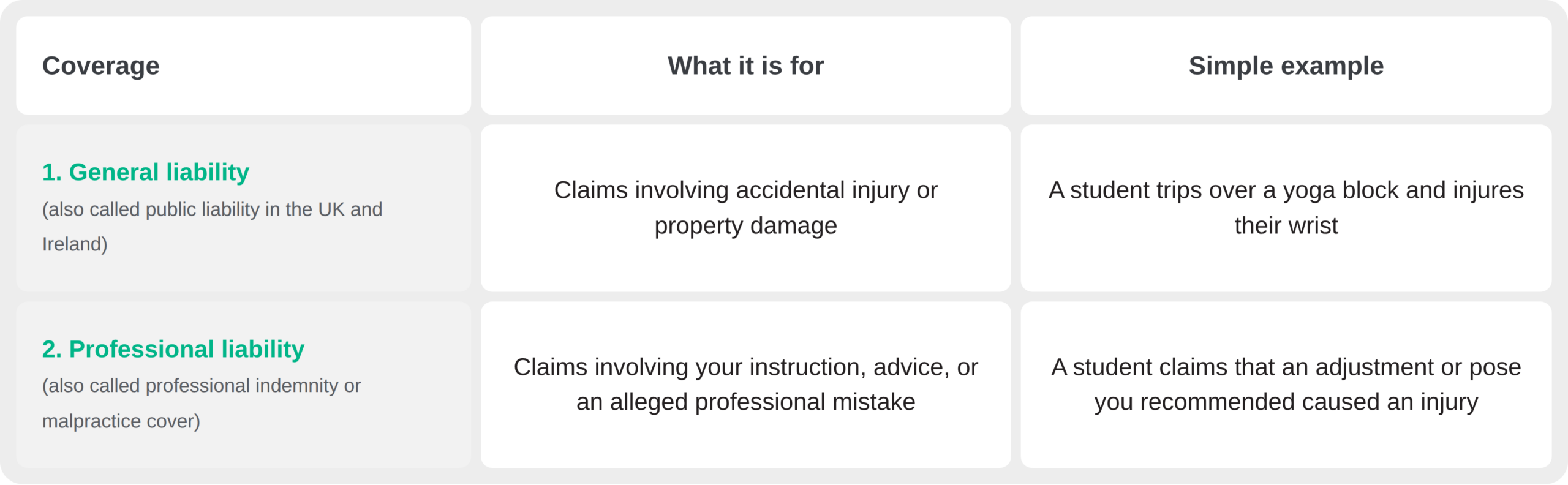
Overall, general liability focuses on accidents connected to the class or teaching space. Professional liability focuses on what you did, or allegedly failed to do, as an instructor.
A policy may combine both, but do not assume it does. The best move is to check the limits and exclusions for each section. It is also worth confirming whether legal fees are included in your coverage limit. If they are, the money spent defending the claim will reduce the amount available to pay it.
For example, if your policy covers up to $1 million and legal fees cost $100,000, only $900,000 would remain to pay the claim.
For a wider look, Cory Sterling talks about the legal essentials fitness operators need to know to be successful.
How Much Does Yoga Instructor Insurance Cost?
For individual instructors in the United States, individual yoga instructor insurance typically starts at around $125 to $189 per year:
- PHLY: $125 for part-time instructors or $185 for full-time instructors
- Insurance Canopy: $159 per year
- Insure Fitness Group: $189 per year
- beYogi: $334 for two years, or $167 per year
These are the advertised prices correct at the time this article was written, July 2026. Your actual cost will depend on your location, coverage, limits, and teaching activities.
If you are a Yoga Alliance member, check your benefits before buying a policy. Yoga Alliance members may qualify for discounted liability insurance.
Read More: How to Open a Yoga Studio: 10 Things You Need to Know
What’s Covered and What’s Excluded on a Yoga Teacher Insurance
A policy name tells you very little. The wording tells you whether it fits your business. Its best to have at least a phone conversation with the person responsible, where you also get to ask questions that we have below in this article.
Common types of coverage
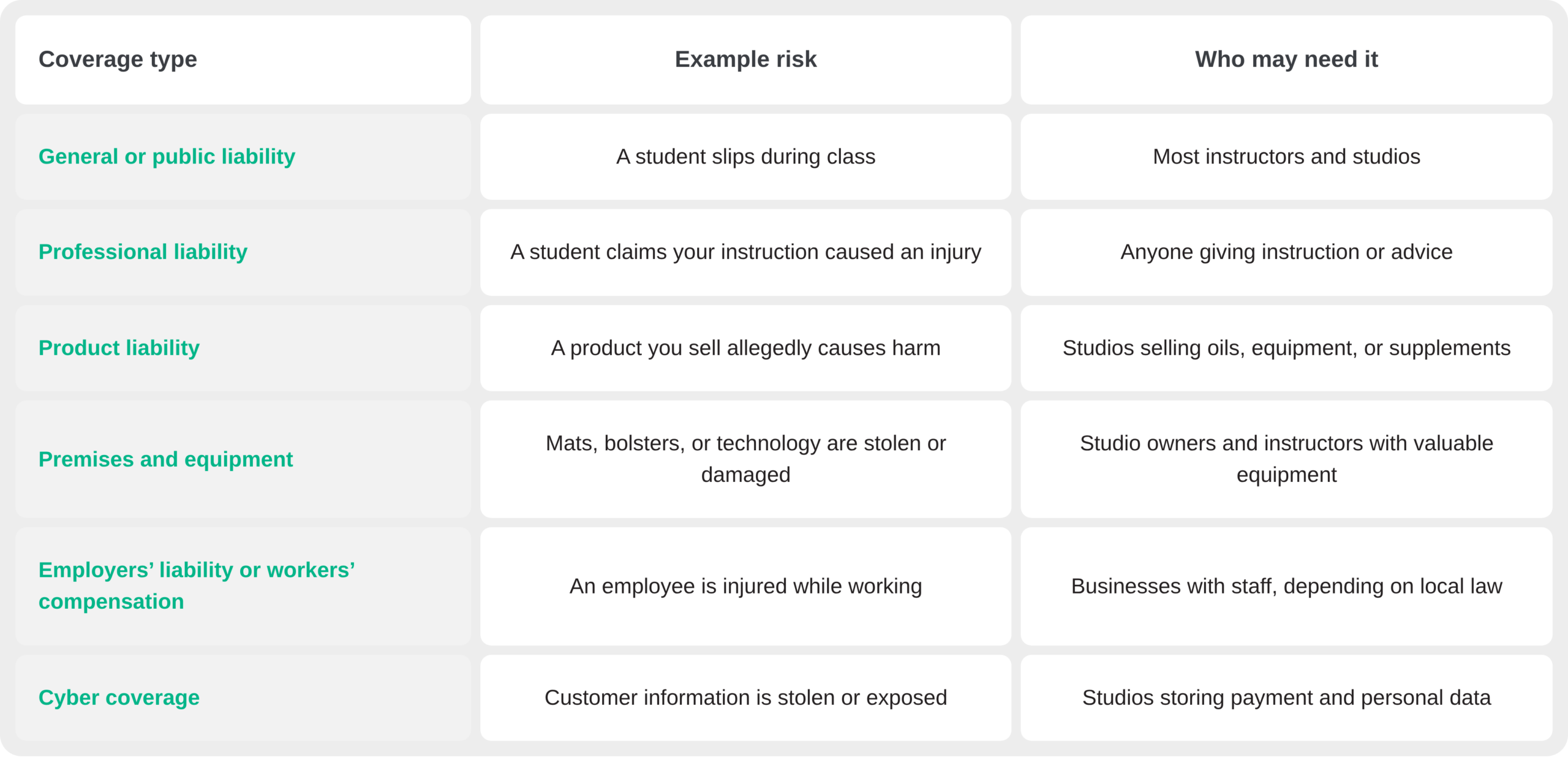
Check Out: Gym Door Access Systems: Secure, Smart Solutions for 24/7 Member Entry
Policy details to check
Read the policy schedule and full wording for:
- The limit for each claim
- The total annual limit
- Your deductible, called an excess in some countries
- Where in the world the policy applies
- Whether legal defense costs reduce the limit
- Which yoga styles and related activities are listed
- Whether rented venues and private homes are covered
- Whether you can add a studio or event organizer as an additional insured
- Whether you can download a certificate of insurance
- How quickly you must report an incident
Also check whether the policy is occurrence-based or claims-made.
Simply put, an occurrence policy normally responds when the incident happened while the policy was active, even if the claim arrives later. A claims-made policy normally requires the claim to be made while the policy is active, subject to its retroactive date and reporting terms.
Choose Your Yoga Teacher Insurance Coverage Based on How and Where You Teach
Now let’s get to more details about your specific yoga teaching practice. Start with your real teaching week and list every place, format, and activity before requesting quotes.
#1 In-person studio classes
Here you get to check whether the policy covers classes at your main studio and other locations. This includes rented rooms, gyms, community centers, parks, and private homes.
If you freelance, ask whether the venue must be added as an additional insured. Confirm how quickly you can request the updated certificate.
#2 Online yoga classes
Do not assume in-person cover includes online yoga classes. Ask whether the policy covers:
- Live video classes
- Recorded sessions
- On-demand libraries
- Private online instruction
- Students watching from another country
- Content that remains online after the policy ends
❗Yoga Alliance advises instructors to confirm online-class coverage directly with their insurer.
#3 Workshops, events, and retreats
There is also a difference between teaching at a retreat and organizing the retreat yourself. The second may involve travel, accommodation, food, transport, and event risks that a teaching policy does not cover.
Here you should check temporary venues, participant limits, and geographical restrictions before teaching at workshops or yoga retreats.
#4 Specialized yoga and equipment
Ask the insurer to confirm every style you teach. Pay particular attention to:
- Prenatal and postnatal yoga
- Aerial or acro yoga
- Hot yoga
- SUP yoga
- Children’s classes
- Pilates
- Sessions using larger equipment
Some policies require specific qualifications. Others cover an activity only after it has been added to the schedule.
Studio owners and instructors need different checks
A freelance instructor mainly needs to confirm their own teaching activities and locations.
A studio owner must also think about the building, staff, contractors, equipment, customer data, and the actions of other instructors. Personal instructor coverage is not a replacement for a studio policy.
For a broader opening checklist, read The 6 Crucial Steps to Opening a Gym or Studio
Top Yoga Instructor Insurance Providers, Compared
The following table provides examples, not rankings or recommendations. Prices and terms can change. Request the full policy wording and confirm that the insurer operates in your jurisdiction.
You do not need the policy with the most features. You need one that covers how and where you actually teach.

Do not choose on price and limits alone. One policy may offer a high limit but exclude the style, venue, or country where you teach.
A Practical Policy Comparison Checklist: Get Your Yoga Insurance in 3 Steps
Use the same questions for every provider. This makes it easier to compare policies that use different language.
- What to ask:
- Where can the policy be purchased and where can claims be brought?
- Are every yoga style and related service I offer listed?
- Are studios, rented venues, homes, parks, and events covered?
- Are live, recorded, and on-demand classes included?
- What is the most the policy will pay for one claim?
- What is the most it will pay across the policy year?
- What will I need to pay toward a claim?
- Which activities, people, locations, and events are not covered?
- Can I add a studio, landlord, or event organizer? Is there a fee?
- Is the policy occurrence-based or claims-made?
- Then give the provider a real scenario:
“I teach two studio classes, one private session in a client’s home, and one recorded online class each week. How would this policy respond if a client claimed that my instruction caused an injury?”
Ask for the answer in writing.
- You should also confirm:
- Which qualifications you must hold
- What client or attendance records you must keep
- How to report an injury or complaint
- When the policy renews
- What happens to existing claims if you cancel
- Whether adding a new class type changes the premium
Review your cover whenever your business changes. Adding online classes, a new instructor, another location, or a retreat can create a gap in a policy that previously worked.
Check Out: How to Open a Yoga Studio: 10 Things You Need to Know
Also Teaching Pilates or Group Fitness? What Changes?
Do not assume a yoga policy automatically covers every class you are qualified to teach. If you also need Pilates instructor insurance, check whether the policy covers mat and equipment-based Pilates. Reformer sessions may be treated differently from mat classes.
For group fitness instructor insurance, list every format you teach. This might include HIIT, strength, dance, cycling, or mobility sessions.
🖊️Ask the insurer to add each activity in writing. Check whether your existing limits, qualifications, and premium will change.
Some providers allow several activities under one policy. Others require an endorsement or separate cover. The important point is that the policy schedule matches the work you actually do.
FAQs
1. Do yoga instructors need insurance?
Often, yes. A studio, venue, client, or contract may require it even when local law does not. Yoga instructor insurance may also protect you when a studio’s policy does not cover freelance, private, online, or off-site work. Check the rules in your jurisdiction and ask every studio what its policy covers.
2. What type of insurance does a yoga instructor need?
Most yoga instructors should compare general or public liability and professional liability. You may also need product liability, equipment cover, personal accident cover, cyber insurance, or employers’ liability or workers’ compensation. The right combination depends on your business and location.
3. Does a studio’s insurance cover freelance yoga teachers?
A studio’s insurance doesn’t always cover freelance yoga teachers. Some studio policies cover employees but exclude independent contractors. Others cover only classes taught at the named location. Ask the studio and its insurer for written confirmation. Freelancers may still need personal coverage and a certificate of insurance.
4. Does yoga instructor insurance cover online classes and retreats?
Some policies do, but the terms vary. For online teaching, confirm live, recorded, and international access. For retreats, confirm the location, length, number of participants, and whether you are only teaching or organizing the wider trip.
5. How much does yoga instructor insurance cost?
The US individual policies in this comparison advertise prices from around $125-$189 per year. Broader cover can cost more. UK quotes can start lower, but the price depends on the instructor, business structure, selected cover, and limits. Always compare the full policy, not only the starting price.
6. What should a Pilates or group fitness instructor check?
Confirm that every class format and piece of equipment is covered. Check qualification requirements, teaching locations, online delivery, and whether higher-risk activities are excluded. Do not rely on a broad phrase such as “fitness instruction.” Ask the insurer to list your activities in writing.
Protect the Business, Then Make It Easier to Run
Insurance can help when something goes wrong. ABC Glofox helps yoga studios manage what needs to go right every day, from bookings and payments to check-ins and member access.
[quote style, larger font] “With the self-serve booking, scheduling, canceling, and the ability for customers to manage themselves, ABC Glofox and Kisi saved our business during COVID-19.” – Ashok Dhariwal, CEO and Owner of YogaFit Studios
Bring the same level of control to your yoga studio.