
Boutique Fitness Studio Marketing: Where Studio Owners Should Focus First


Get the monthly playbook digest
Unsubscribe any time.
Right now, the challenge with boutique fitness studio marketing isn’t finding tactics; there are more fitness studio marketing ideas and channels out there than most studios can afford to choose and invest in. The challenge is finding the ones that are worth your focus first.
In this article, we will list the best low-budget fitness studio marketing based on what you already have: your members, your classes, and your neighborhood.
If you’re still pre-launch and hunting for your first 100 members, start with our boutique fitness studio launch checklist instead. This article is for the studio that’s already open, where you’re teaching classes and handling everything with a lean team.
That’s what this checklist is: six areas of small fitness studio marketing, ordered by where a solo owner should focus first, each one executable in the gaps of a normal studio week.
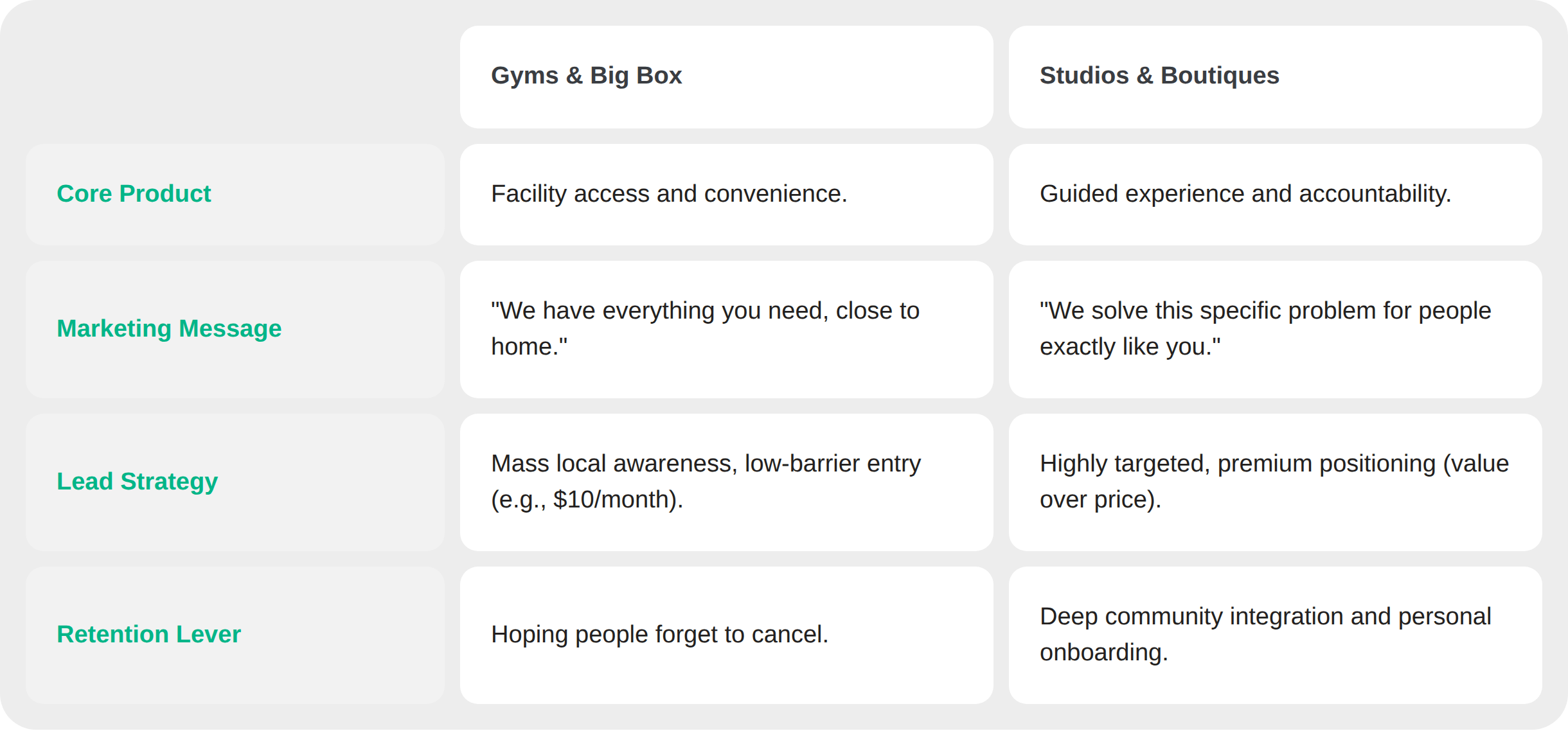
Most gym marketing advice is written for big-box gyms, and it shows. Paid mass advertising, billboards, and always-on promo cycles assume a marketing team and a media budget. When it’s you covering the front desk between classes, copying that playbook doesn’t just fail, it drains the little time and money you have.
The industry data backs this up. According to ABC Fitness’s Mid-Year 2026 Wellness Watch Report, drawn from 30,000 fitness businesses serving 40 million members, new member acquisition is slowing across the board:
But look at what happens after the join, and the two models split completely:
In other words, big-box gyms are stuck on an acquisition treadmill, spending to replace the members walking out the back door.
Also, a big-box gym expects high churn and compensates with massive lead volume. A studio simply doesn’t have the footprint to survive that kind of churn; their entire model relies on high-ticket retention.
Studios that get it right have one major win, their community.
The same report found 67% of members say community is their biggest driver of motivation and accountability (up 12% year-over-year), and 57% say belonging to a fitness community significantly impacts their long-term commitment.
Nobody joins a boutique studio because it’s the cheapest option or has the most treadmills. They join because the coach knows their name, the 6 p.m. crew feels like their people, and progress gets noticed.
That’s why your playbook can’t be a shrunken version of a gym’s. Their model is built on volume: acquire cheaply, accept churn, repeat. Yours is built on connection: keep the members you have engaged, and let them bring the next ones through the door. Which means your best marketing channels are the ones that put your members and your neighborhood to work, not your wallet.
That’s the filter behind every item in this boutique fitness studio marketing checklist: can one owner execute it directly, in a normal studio week, without hiring a marketer? If a tactic needed a budget line or a full-time hire, it didn’t make the list.
Read More: Fitness Studio Business Strategy: Grow, Scale & Succeed
Here’s the good news: with organic social for fitness studios, the boutique owner has the advantage. You don’t need influencer budgets or a paid ads machine, and honestly, they’d work against you.
What performs for studios right now is the opposite of polished: actual members, branded classes, real neighborhood.
#1 Post your people, not productions
Member-generated footage consistently outperforms produced content for this audience. A shaky clip of the 6 p.m. crew finishing a tough set beats a professionally shot promo, because prospects aren’t buying equipment — they’re deciding whether they’d fit in.
Short-form video is your core format: class moments, member transformations, instructor personality. Ask permission once, then make capturing one clip per class a habit.
Check Out: 25 Instagram Post Ideas for Gyms and Fitness Studios to Boost Engagement & Drive Memberships
#2 Pick a lane instead of preaching fitness for everyone
“Fitness for everyone” is big-box positioning, and you can’t outshout a big-box gym. What you can do is own a niche: strength for runners, low-impact for new moms, powerlifting for beginners.
The tighter your positioning, the easier it is to filter fitness studio marketing ideas. You know exactly what to post, who it’s for, and which trends are worth jumping on.
The same logic applies whether you run a Pilates studio or a yoga studio: niche content converts because it makes the right person think “this is my place.”
#3 Sell the third space, not the workout
More people — especially younger members — are swapping bar nights for gym sessions and looking for a third space between home and work.
Your content should show that: the post-class coffee huddle, the members who became friends, the community events. You’re not competing with the gym down the street on price; you’re competing with every other place someone could belong.
#4 Respond fast when the DM comes
Organic content generates leads at unpredictable hours, and speed to lead decides whether they convert. Remember this: someone who DMs “how do I try a class?” and hears nothing for two days has already moved on. But that doesn’t mean you should become obsessed with checking your socials.
Now you can automate this easily with an instant reply containing a booking link, followed by a personal follow-up when you’re between classes. This is where your studio software earns its keep: lead capture and automated follow-up run while you’re teaching.
Read More: How ABC Glofox Simplifies Difficult Conversations With Your Members
#5 Keep the cadence honest
Three to four posts a week, captured during classes you’re already teaching, beats a daily schedule you’ll abandon by March. Add local hashtags and geotags to everything, you’re not trying to go viral, you’re trying to be seen by people within ten minutes of your front door.
Read More: A Q1 2026 Onboarding Playbook for European Gyms & Fitness Studios
If organic social fills the top of your funnel, referrals are what fill your classes. And the economics aren’t close. ABC Fitness breaks down the math in the Profit Acceleration ebook:
[larger font, quote style] “A referred prospect costs $0–$50, converts at 35–50%, and reaches profitability in three to six months. They also stay around 30% longer, because they arrive already convinced the studio works and with a friend built into their routine.”
That data comes from studying gyms and multi-location operators, and here’s the thing: the advantage gets bigger at boutique scale.
A big-box gym has to engineer referral behavior across thousands of anonymous members. You already know which of your members would happily bring a friend. Your whole model runs on the relationships a fitness studio referral program is designed to exploit.
So why doesn’t every studio run one? Because most referral programs are built to be ignored with multi-step processes and buried links. The fix comes down to three principles, translated for a studio:
#1 Make it effortless
A buddy pass is the simplest version: every member can bring a guest to one class, free, no forms. If a member has to remember a link or explain an offer, the referral won’t happen. Ideally it’s one tap in your studio’s branded app, a pre-written message with the member’s own tracking link, shareable by text.
#2 Reward both sides, immediately
The friend gets their first class free or a discounted first month; the referring member gets an account credit the moment their friend joins, not next quarter. Then let it ladder up for your regulars: a credit for the first referral, a free month at three, a free PT session at five. Small studio, small numbers, same psychology.
#3 Ask at the high point
The best moment for a referral ask isn’t a monthly email blast, it’s right after a member hits a milestone: their 50th class, a personal best, a transformation photo they’re proud of. That’s when “bring a friend next week” feels like an invitation, not a pitch.
The reason this stays cheap is that none of it needs a budget, just tracking, so no referral slips through the cracks.
If you’re running on ABC Glofox, referral tracking, automated rewards, and the follow-up messages all run inside the platform you already use for bookings, so the program manages itself while you teach. A realistic target from our internal data:
15–20% of your members referring at least once a year. For a 150-member studio, that’s 20–30 warm leads annually, at near-zero cost.
Free Resource: Profit Acceleration: A 90-Day Playbook for Sustainable Gym Growth
When someone nearby searches “pilates studio near me,” you either show up, or you don’t. The fundamentals of local SEO for fitness studios haven’t changed, and we’ve covered each in depth already, so here’s the checklist:
What has changed is where those searches happen. AI Overviews now show up on roughly 46% of local-intent searches, and people ask ChatGPT for studio recommendations directly.
For big brands, AI visibility takes years of content and PR. For local queries, AI pulls from the same four assets above:
As for results: profile changes affect map visibility within two weeks, reviews compound over 30–60 days, and AI answers are the slow burn at 2–4 months, which is exactly why the setup week happens now, not when a competitor gets there first.
Pro Tip:
Here is the exact, step-by-step framework to audit the AI visibility health of any boutique studio:
If you’re not familiar with them, a fitness class challenge does a lot in one go: it brings in new members, keeps current ones coming back, and gets people talking about your studio to their friends.
It builds exactly the kind of accountability and belonging this article keeps circling back to. It’s the same community energy that helped KOMO Studio, a community-focused pilates studio in Hawaii, grow revenue by 33% in twelve months, just packed into four weeks instead.
The smartest way to go about this is to keep the format simple: a two-to-four-week attendance challenge, something like “12 classes in 30 days.” Attendance beats performance here, since a member who’s just started working out can actually win it, and beginners are exactly who you’re trying to convert. Here’s how to run one:
Overall, we suggest running a challenge per quarter. Cap participation at 15–30 new members per challenge. For formats and mechanics, read our in-depth guides:
Turn more leads into paying members: grab our free Pilates Studio Toolkit, including a full lead-to-member conversion playbook.
Everything above works better when the community underneath it is real.
Les Mills’ recent MVP report, which tracked 2.6 million member journeys, found that highly connected members:
And 73% of members say community is crucial to staying motivated: they join for health, but stay for connection.
You don’t need an events budget to build that. Four habits:
This is how to promote a boutique gym without ad spend: make the community so good that members do the talking.
For the full playbook, grab our free ebook, 6 Keys to Building a Loyal Fitness Community.
Copy and steal this from us, and take note of what brings more and faster growth for your studio:
If you’re wondering how to promote a boutique gym on zero budget, start with referrals and organic social media, both cost nothing but time. A simple buddy pass program turns existing members into your sales force, while member-generated short-form video fills the top of your funnel. Add a complete Google Business Profile, and you’ve covered the three highest-ROI marketing channels for free.
A member invites a friend, the friend gets a free first class or discounted first month, and the member gets an immediate reward like an account credit. The keys are making sharing effortless (one tap, pre-written message), rewarding both sides instantly, and asking at high points like milestones. Referred members convert at 35–50% and stay longer than any other lead source.
Yes, it’s where “near me” searchers and, increasingly, AI overviews find you. The minimum: a complete Google Business Profile, a steady flow of reviews, consistent listings in local directories, and your neighborhood and class type in your page titles. Most of it is a one-week setup.
Three to four times a week, captured during classes you already teach. A sustainable cadence beats an ambitious one you’ll abandon, consistency and local hashtags matter more than volume or polish.
Combine the boutique fitness studio marketing levers in this checklist: organic social to attract, local SEO to get found, referrals and class challenges to convert, and community to retain. Each feeds the next: a challenge creates content, content brings prospects, prospects meet your community, and your community refers the rest.
None of these tactics are complicated. That’s the point, boutique fitness studio marketing isn’t about doing more; it’s about doing a handful of low-cost things consistently:
The hard part is consistency when you’re also the coach, the front desk, and the accountant.
Every tactic in this checklist depends on something happening automatically: the instant DM reply, the referral credit, the review ask after a first class, the challenge leaderboard updating itself. Do all of that manually and the system breaks the first busy week you have.
That’s exactly what ABC Glofox was built for. Bookings, lead capture, referral tracking, automated messages, and a branded member app, the whole engine behind this article, running in one place while you teach. It’s why studios like KOMO grew revenue 33% in a year without adding a marketing hire.
You bring the community. We keep the machine running. Get a free demo and see how much of this checklist you can put on autopilot this month.