

TL;DR: Opening a yoga studio in 2026 means blending the fundamentals, business plan, funding, location, licensing, with modern demand: hybrid wellness, recovery-focused programming, and systems that run your studio without running you. This guide covers what to build first, what to postpone, exactly what it costs by studio type, and the 12 steps that take you from idea to opening day.
Skip Ahead:
- Yoga Studio Trends to Build Around in 2026
- How to Open a Yoga Studio in 12 Steps
- What It Costs to Open a Yoga Studio
- The Benefits of Opening a Yoga Studio
- 3 Examples of Great Yoga Studios
- Common Mistakes to Avoid When Opening a Yoga Studio
- Opening a Yoga Studio Checklist
- FAQs
- Conclusion
Turning a love of yoga into a business you actually own is exciting, and a little intimidating. It’s also more possible than ever: the U.S. yoga market is worth $27.9 billion and growing 9.3% a year, with 16.9% of American adults now practicing regularly, fueled by the rise of the hybrid wellness studio model.
But more demand also means more competition, and more ways to get the fundamentals wrong before you even open your doors.
Opening a yoga studio isn’t one decision, it’s a sequence of them: the business model you choose, the plan behind it, the funding, the space you sign for, the licenses that make it legal, and the systems that keep it running once members start showing up. Skip a step and it tends to resurface later, as a cash flow problem, an empty class schedule, or a studio that never quite finds its people.
Yoga Studio Trends to Build Around in 2026
Before you sign a lease or design a logo, it helps to know what’s actually working in yoga right now, and what’s a distraction. The fastest-growing parts of the market are community-first “third space” studios, recovery and nervous-system-regulation formats, and hybrid access that extends class beyond the four walls.
3 Main Things to Prioritize in Year One:
- Community: Build the “third space” feel, comfortable lounge areas, coffee, a reason to linger, before you invest in high-tech extras.
- Strength integration: Add at least one class that blends yoga with resistance work to capture the broader fitness market, not just traditional yogis.
- Recovery: If you have the square footage, a cold plunge or infrared sauna corner tends to deliver the highest return per square foot of any addition.
What to postpone until membership is stable
Other high-tech yoga trends include immersive projection mapping, VR headsets, and expensive motorized wall systems. They look impressive, and there’s data linking them to real bottom-line revenue, but it’s better to hold off on that investment until your membership base is stable.
Low-cost formats worth piloting in month one
- Walking yoga or a run-club tie-in (zero facility cost, high community value)
- Mat Pilates or barre-style flow (minimal equipment, high perceived value)
- Restorative yoga (broad appeal, no need for expensive heat or sound systems)
Read More: The Yoga Studio Playbook for 2026: Trends That Actually Matter
How to Open a Yoga Studio in 12 Steps
Once you know what you’re building toward, here’s exactly how to open a yoga studio, step by step.
1. Decide What Type of Yoga Business You Want to Start
Before signing a lease or designing a logo, the most important decision you’ll make is choosing what kind of yoga business you want to build. Some owners open traditional brick-and-mortar studios, while others choose boutique spaces with a curated, premium feel.
Many are launching online-only businesses or a hybrid wellness studio model that combines in-person classes with virtual options. Others focus on a niche: prenatal yoga, hot yoga, trauma-informed yoga, or corporate wellness.
There’s no single “right” model. The best choice depends on your lifestyle, financial goals, local demand, and the type of experience you want to create. Whatever you choose, lock in your brand identity early, name, colors, tone, since it touches every other decision from your website to your class descriptions.
Check Out: The Different Types of Fitness Studios (And How to Choose Yours)
2. Research Your Local Market
Next, look at who’s already teaching yoga near you, and who isn’t. Study competitors’ pricing, class formats, and reviews to identify gaps.
Talk to potential clients directly: what’s missing from their current studio experience? A quick local market scan, competitor schedules, pricing, and Google reviews, tells you whether your area needs another traditional Vinyasa studio or has room for something more specific, like a recovery-focused or menopause-yoga niche.
3. Create a Yoga Business Plan
You don’t need a 40-page document, but you do need a clear yoga business plan that outlines your vision, services, pricing, target audience, and how you want the business to scale over time. Your yoga business plan will be at the core of everything you do. It helps you secure funding and shows investors, or just yourself, why the business will work.
Key elements to include: customer analysis, competitor analysis, marketing plan, and financial projections. For guidance on structuring the plan itself, you can download our template.
Read More: How to Create a Seamless Fitness Business Plan.
4. Understand Yoga Studio Startup Costs
Before you execute your plan, it’s important to understand realistic yoga studio startup costs. They vary widely depending on your business model and location: a bare-bones studio might run around $24,000, while an established boutique space can reach $150,000 or more.
Online or hybrid studios have lower overhead but still require investment in technology and content creation.
A good rule of thumb: total your projected startup costs, then add another 25% as a buffer. Unexpected expenses are what sink first-time studio owners, not the ones they planned for. We break down the full cost table by studio type below.
Read More: The Economics of Owning a Gym in 2026
5. Secure Funding
Once you know your number, figure out how you’ll cover it. Options include:
- Personal savings
- A small business loan
- SBA-backed financing
- Bringing on a co-investor
Lenders will want to see the business plan and cost breakdown you just built, so don’t skip those steps.
If you’re comparing funding routes, the SBA’s guide to funding your business walks through loans, grants, and investor options before you approach a bank.
Read More: Everything You Need to Know About Gym Financing
6. Choose the Right Location (or Online Model)
Your yoga studio location plays a vital role in the success of your business. Look for a space that’s easy to access, aligned with your target demographic, and supported by lease terms that won’t strain your finances. Visibility and foot traffic help, but convenience and community fit often matter more than a prime storefront.
For online or hybrid businesses, your “location” becomes your digital experience. Reliable technology, high-quality audio and video, and a seamless booking process are what create trust with remote students.
Read more: Finding the Right Location For Your Fitness Business
7. Register Your Business, Get Certified, Licensed, and Insured
Running a yoga studio requires more than teaching expertise. You’ll need to register your business (most owners choose an LLC for liability protection), plus:
- A registered business license ($250–$1,000 depending on your city)
- Liability insurance and a professionally drafted liability waiver
- Yoga Alliance registration for yourself and any instructors you hire, so your credentials are recognized industry-wide
- Music licensing through ASCAP or BMI if you play licensed music in class (yes, this is genuinely required, and genuinely overlooked)
Requirements vary by region, so research local regulations before opening. Taking care of these details early builds credibility and ensures your business operates professionally from day one.
Haven’t landed on a studio name yet? Check out: 50+ Yoga Studio Name Ideas to Inspire Your Brand
8. Design Your Class Schedule and Pricing
Your schedule and pricing structure should support both your students and your energy as a business owner.
Offer a thoughtful mix of beginner, intermediate, and specialty classes to attract a broad audience without overwhelming your team. Workshops, series, and intro offers add value and create additional revenue streams.
When it comes to pricing, simplicity wins. Clear options like drop-ins, class packs, and monthly memberships make it easier for potential clients to commit and stay consistent.
Read More: Yoga Class Prices: Are you Setting Them Correctly?
9. Set Up Systems for Scheduling, Payments, and Memberships
Strong systems are the backbone of a sustainable yoga business. Managing schedules, bookings, payments, and memberships manually becomes overwhelming fast as your studio grows.
Purpose-built studio management software like ABC Glofox’s yoga studio software lets you automate bookings, manage recurring memberships, accept payments, and communicate with members in one place.
That saves time and creates a smoother, more professional experience for your students.
6 Keys to Building a Loyal Fitness Community
Discover moreFree resource: The Key Features to Look for in Great Yoga Studio Software
[banner] Need a foundational tool to help scale your studio? Meet ABC Glofox’s Yoga Studio Software
10. Hire Instructors and Build Your Team
Your instructors shape your studio’s culture as much as you do. Whether you hire contractors or employees, set clear expectations around teaching standards, compensation, and communication.
Hire people with Yoga Alliance-recognized credentials, and double-check they’re genuine before bringing them on.
Check out: How to Hire the Best Manager for Your Fitness Business
11. Market Your Yoga Business Before You Open
One of the biggest mistakes new studio owners make is waiting until opening day to market. Successful studios build momentum weeks or months in advance through:
- Founding-member offers
- Early-bird pricing
- Referral incentives
- Email waitlists
- Social media engagement
Read More: How to Create a Yoga Studio Marketing Plan
12. Open Your Doors
On opening day, the goal isn’t perfection, it’s momentum. Confirm your systems are tested (booking, payments, check-in), your instructors know the schedule cold, and your first-week promotions are live.
Many studios host a grand-opening event or free community class to convert waitlist sign-ups into paying members in week one. Then shift focus immediately to onboarding: how you treat your first 30 days of members shapes whether they renew.
Read more: 6 Effective Yoga Marketing Tips to Take Your Studio to the Next Level
What It Costs to Open a Yoga Studio
Short answer: a yoga studio costs anywhere from roughly $24,000 for a minimalist setup to $150,000+ for an established boutique studio, and $250,000 or more for a premium or hot yoga build-out, with location, square footage, and HVAC or mechanical needs driving most of the difference.
Studio size matters more than people expect. A minimalist studio typically runs about 400 square feet and serves up to 20 clients per class, while an established boutique studio needs closer to 750 square feet to comfortably hold 30.
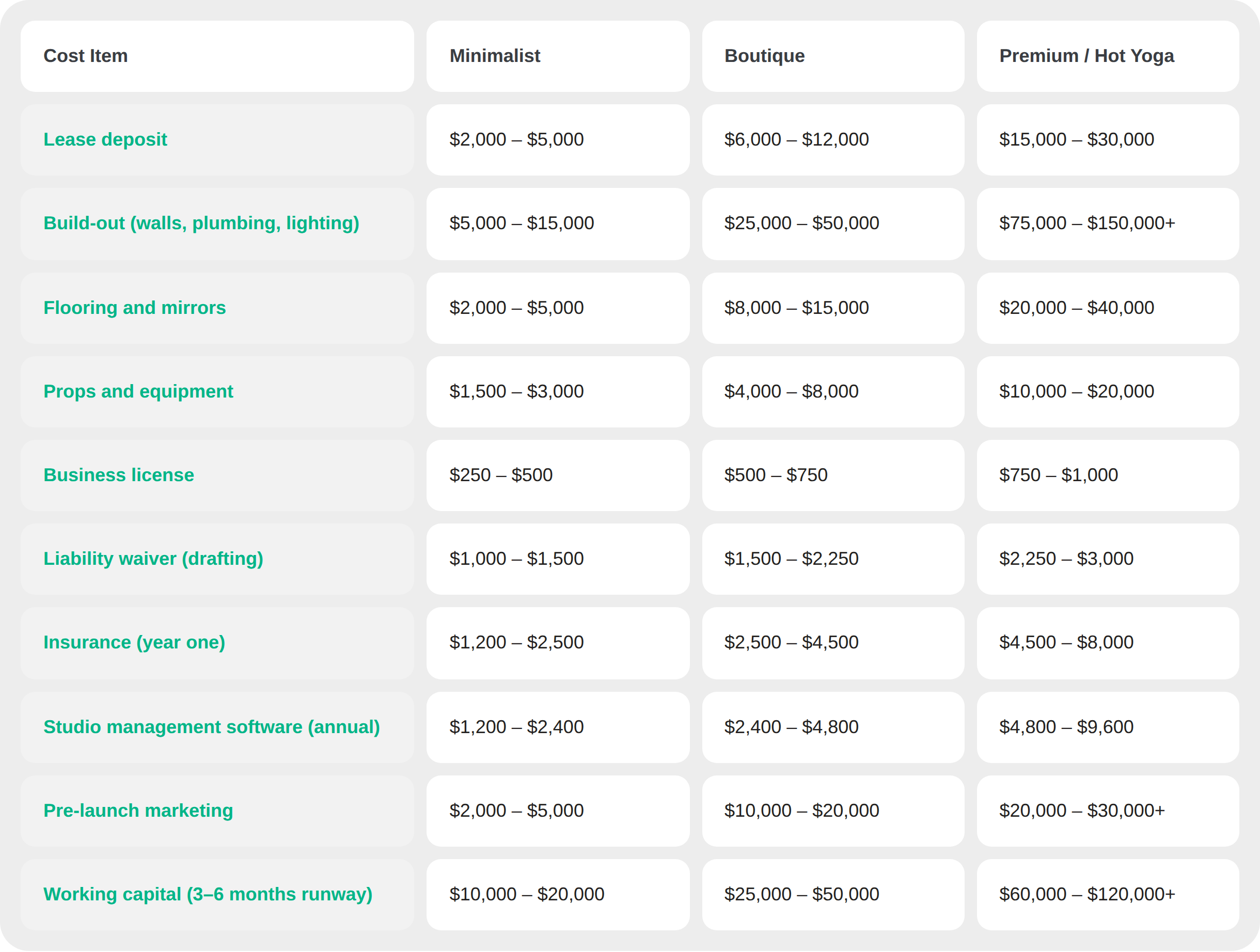
* Figures are adapted from broader fitness-industry startup benchmarks, scaled to yoga-studio square footage and format, and should be used as planning ranges, not quotes. Actual costs vary by city, landlord, and build-out scope.
Note: Hot yoga vs. Vinyasa: the HVAC gap. One line item trips up more first-time owners than any other: climate control. A standard Vinyasa or Hatha studio can usually get by with a solid commercial HVAC system. A hot yoga studio cannot. Heating a room to 95–105°F consistently, safely, and without warping your flooring requires specialized climate-control equipment, and mechanical upgrades of this kind can run well over $100,000 on their own. If you’re planning a hot yoga studio, budget separately for HVAC before you fall in love with a lease.
Don’t skip the working capital line. It’s the number most first-time owners get wrong, and the one many cost breakdowns leave out entirely. Plan for three to six months of rent, payroll, and software costs before you open your doors, not after.
Don’t Skip This: The Economics of Owning a Gym in 2026
The Benefits of Opening a Yoga Studio
Yoga isn’t the only place to put your capital, but it’s one of the few fitness categories where demand, pricing power, and recurring revenue all point the same direction.
- Global demand keeps climbing. The yoga market is on track for $269.1 billion by 2033, so you’re building in a category that’s still expanding, not fighting for share in a shrinking one.
- People pay for outcomes, not just workouts. 80% of practitioners practice yoga to restore their health, not simply to exercise, which supports membership pricing over one-off, discount-driven visits.
- Certification is a built-in head start. If you already hold a Yoga Alliance registration, you walk in with credibility and community most first-time owners spend years building from scratch.
- The revenue model rewards retention. Unlike single-visit fitness formats, yoga studios run on memberships, so keeping members matters as much as attracting them.
Check out: Best Practice Retention Strategies for Fitness Businesses
3 Examples of Great Yoga Studios
A multi-location studio built around variety, offering a wide range of class formats and membership levels rather than one single style. When COVID-19 made contactless entry and remote oversight essential, the team paired ABC Glofox with Kisi’s access control for self-serve booking and entry, plus one dashboard to track members, cash flow, and check-in activity across every location.
Founder Alex Du Toit opened Baraza in May 2019 after moving from Cape Town and missing the yoga culture she’d left behind, building the studio on what she calls “blind hope, faith, and a lot of hard work.” It’s since grown into a community of around 1,000 active members. After two frustrating years on Mindbody, she switched to ABC Glofox for its branded member app and built-in trainer payroll tools, calling the change a way to get “control again over my business.”
Founder Wal Nunes launched Studio Integral in 2011, not as a business plan but as a way to share yoga and mindfulness with family and friends. It’s since grown into a full studio running on ABC Glofox’s bookings, payments, and business analytics, with revenue up over 150% in twelve months, enough to move into a larger space.
Read More of Our Customer Success Stories
5 Common Mistakes to Avoid When Opening a Yoga Studio
Even with strong demand, plenty of new studios struggle in year one, and it’s rarely because the owner didn’t care enough. It’s usually one of a handful of avoidable missteps that quietly drain time, money, or momentum before the business finds its footing. Here’s what trips up first-time studio owners most often:
- Hiring the wrong staff. Bring on people who share your passion, not just fill a vacancy.
- Not having a real plan. Treat it like a business from day one.
- Overspending on the wrong location. Check access, parking, and transport before signing anything.
- Not knowing your clients. Ask real students what they want before locking in your offering.
- Skimping on marketing. Your yoga network is a start, not a strategy.
Opening a Yoga Studio Checklist
Use this opening a yoga studio checklist to confirm you haven’t missed the essentials before you open your doors:
- Legal structure (LLC or equivalent) registered
- Yoga Alliance registration for you and your instructors
- Liability insurance and signed waivers in place
- Music licensing secured through ASCAP or BMI
- Studio management software set up (scheduling, payments, memberships)
- Pre-launch marketing running (waitlist, social, founding-member offer)
FAQs
- Is owning a yoga studio profitable?
Yes, but profitability depends on pricing, member retention, and operational efficiency. Studios that prioritize memberships and automation over one-off drop-ins tend to be more sustainable over time.
- How much does it cost to start a yoga business?
Costs range from a few thousand dollars for an online-only model to $150,000 or more for an established boutique studio, and higher still for premium or hot yoga build-outs. See the full cost breakdown above in this article.
- Do I need to be a yoga teacher to own a yoga studio?
No. Many successful studio owners focus on operations and hire Yoga Alliance-certified instructors to teach classes.
- What systems does a yoga studio need?
At minimum, studios need tools for scheduling, payments, memberships, and communication. Purpose-built software like ABC Glofox’s yoga studio software simplifies these processes and supports growth as you scale.
- What licenses do I need to open a yoga studio?
At minimum: a business license, liability insurance, a signed liability waiver, Yoga Alliance registration for instructor credentials, and music licensing through ASCAP or BMI if you play licensed music in class.
- How long does it take to break even?
Most yoga studios take between six and eighteen months to reach consistent profitability, depending on expenses, pricing, and retention.
- How do I start a yoga studio business?
Follow the 12 steps above: decide your model, research your market, build a yoga business plan, understand your costs, secure funding, choose your location, handle registration and licensing, set your schedule and pricing, set up your systems, hire your team, market before you open, then open your doors.
Ready to Open Your Yoga Studio?
Opening a yoga studio takes more than a love of the practice, it takes a plan, the right systems, and technology that runs quietly in the background so you can focus on teaching. Whether this is the first time you’ve searched how to start a yoga studio business or you’re refining your fifth location, the fundamentals stay the same.
ABC Glofox helps yoga studio owners handle scheduling, memberships, payments, and communication in one place, so nothing falls through the cracks in your first year. On average, studios on ABC Glofox see a 250% lift in lead generation, cut admin time by 40%, and double revenue within 18 months.
Get your free demo of ABC Glofox today