

TL;DR: A gym promotion strategy that relies only on discounts trains prospects to wait for deals before joining. This post covers how to choose the right offer type, protect your brand positioning, and measure whether a promotion actually paid off.
Gym promotions work. The problem is how most gyms run them.
A well-designed gym promotion strategy drives new memberships, fills capacity gaps, and reactivates lapsed members. A poorly designed one conditions your audience to wait for the next deal before joining at full price.
Gym promotions aren’t the enemy. The threat lies in ad-hoc gym promotions that erode perceived value. This article covers when discounts make sense, how to promote a gym without cheapening your brand, and how to measure whether an offer was actually profitable. We also include a list of gym promotion ideas designed to drive results.
Whether you’re planning your first seasonal offer or refining your gym discount strategy, start here for a framework you can trust. Let’s get started!
View this post on Instagram
Should Gym Owners Offer Discounts on Memberships?
The answer is yes, in the right context. But leading with a discount is not necessarily how to start. In fact, a gym discount strategy built around habitual discounting can create more problems in the long run than it solves.
When discounts make sense
Discounts can earn their place in a gym promotion strategy under specific conditions. Genuine demand peaks, like the beginning of January or back-to-school season, are two examples. Time-bound discounts reduce the barrier to action for prospects who were already close to converting.
Reactivating lapsed members who left for price-related reasons is another valid use case. A targeted win-back offer with a personal outreach can recover members who valued your gym but couldn’t justify the price
A third scenario is when you need to fill specific capacity gaps, like off-peak classes or a new timeslot with no established audience. Here, a lower entry price serves a genuine operational purpose.
When discounts backfire
The risk accumulates when discounts become habitual. The research is consistent: heavy gym promotions reduce perceived value and attract short-term, price-driven members who churn faster and deliver lower lifetime value.
Running three or four discount events a year signals to your market that full price is the exception. So, members learn to wait.
Premium studios are especially vulnerable: a price cut at a boutique gym signals that the experience isn’t worth what it costs.
The better starting question
Before setting the offer, define what the promotion needs to accomplish: acquisition, reactivation, upsell, or retention? The goal determines the offer type, and often reveals that a discount isn’t needed at all.
📝 Read More: How to Drive Revenue and Provide Exceptional Value With Your Gym Pricing
The research is consistent: heavy gym promotions reduce perceived value and attract short-term, price-driven members who churn faster and deliver lower lifetime value.
What’s the Difference Between a Discount Promotion and a Value-Add Promotion?
These two offer types produce different results and carry different risks. Knowing when to use each is key to your gym promotion strategy.
#1 – Discount promotions
A discount promotion reduces the price of an existing membership or service. Common examples: first month free, 20% off an annual membership, or a waived enrollment fee.
The risk is overuse. A well-timed discount for a specific acquisition window makes sense. A discount that runs every other month anchors the prospect’s perception of value at the lower price.
Pricing psychology matters here: showing the original price alongside the promotional price (also known as anchoring) makes the offer feel more valuable by giving the prospect a reference point.
#2 – Value-add promotions
A value-add promotion keeps the membership price the same and adds something to the offer: a free personal training session, guest passes, branded merchandise, or access to challenge programs.
In these scenarios, members feel they’re getting more, not that the gym is worth less. This distinction matters most for high-end or boutique gyms, where the price point communicates the quality of the experience.
The decoy effect is relevant here, too: positioning a mid-tier membership with a value-add bundle makes it the obvious choice without requiring a price cut on any tier.
“ABC Glofox is an investment that helps me to stand out.” – Vikki Gladney, Natural Measures Cycling
Which one to use
The key to knowing how to promote a gym effectively is matching the offer type to the context. Let’s take a closer look:
- Value-add gym promotions are the right choice for premium studios, new program launches, loyalty rewards, and any scenario where brand positioning is part of the value.
- Discount gym promotions make sense for high-volume acquisition windows where price is the genuine barrier.
📝 Read More: 9 Affordable Ways to Promote Your Gym Online: Gym Marketing Ideas That Actually Work
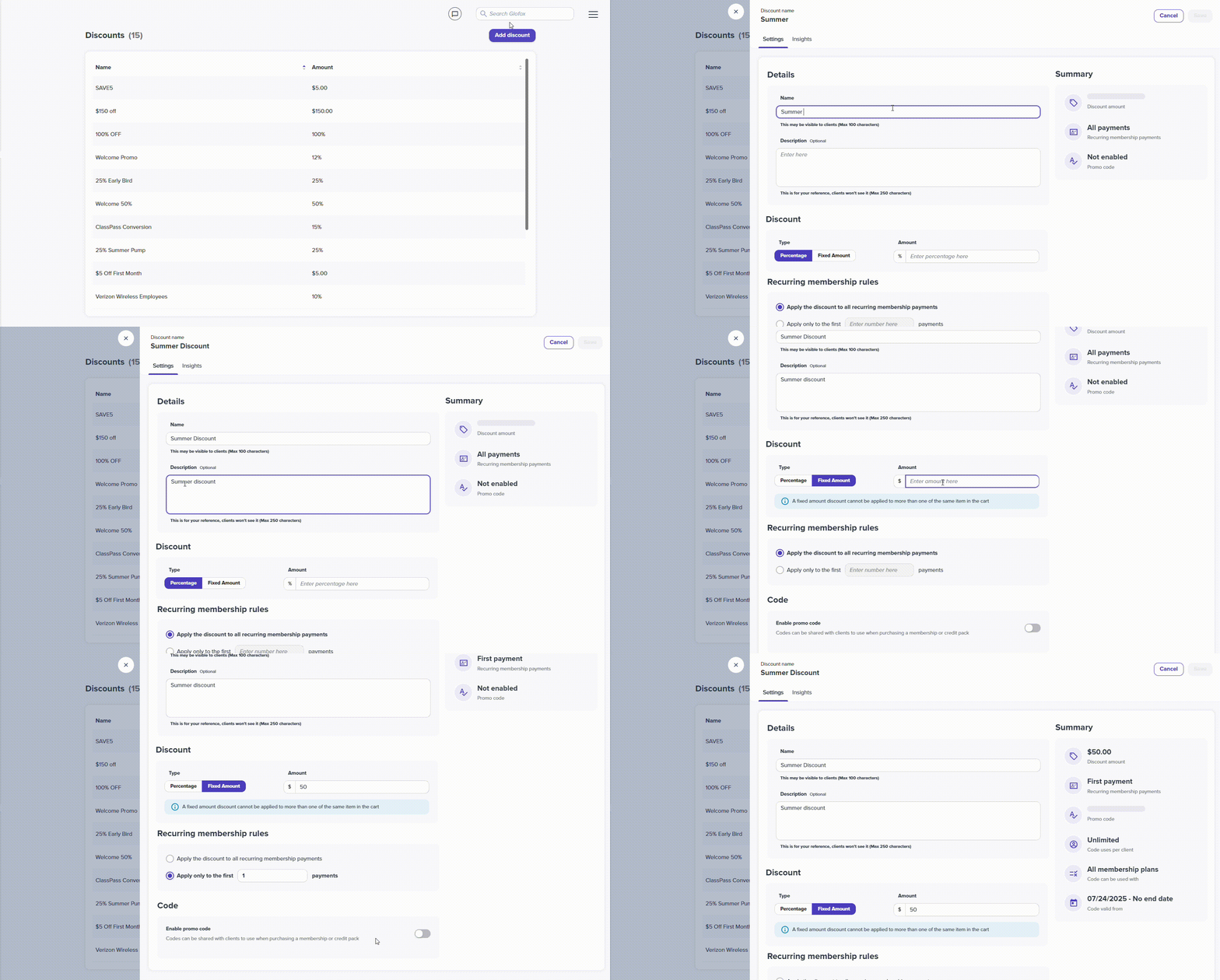
ABC Glofox makes it easy to set up gym promotions, campaigns, and discounts.
How Do You Run a Gym Promotion Without Cheapening Your Brand?
A gym promotion strategy that protects brand positioning follows a few consistent rules before any offer goes live.
#1. Set a discount floor before you run any offer
Decide the minimum membership value you’ll protect and hold to it. So if your standard monthly membership is $89, decide in advance that you’ll never promote below $69 (and if so, reserve it for one or two specific windows per year).
Also factor in member lifetime value: A new member acquired at $69 who stays for 12 months is worth $828; one who churns at 60 days is worth far less.
The key is a clear gym discount strategy with a defined floor.
#2. Cap how often you discount in a year
Running 4+ discount events a year tells prospects that full price is optional. A practical ceiling for most gyms is 1-2 major discount promotions per year timed to genuine demand peaks (e.g. January). All other promotions should run as value-add or non-price incentives.
#3. Use value-add offers when it fits
If you’re launching a new class or studio anniversary campaign, value-add gym promotions work better than price cuts. The same is true of loyalty rewards. Adding a free PT session or free training time to a new member sign-up creates excitement; it also protects the membership price while still creating urgency.
#4. Build a conversion step into every offer
Finally, every gym promotion needs a clear path from interest to membership: a booking link, landing page, or automated follow-up sequence.
📝 Read More: Gym Marketing in 2026: What’s Working & What’s Not

How Do I Measure Whether a Gym Promotion Was Profitable?
You don’t need a finance background to tell if your gym promotion worked. All you need is a structured approach to the question with numbers.
Set a baseline before the promotion runs
Record 3 numbers before the offer launches:
- Active member count
- Average monthly membership value
- Trial-to-member conversion rate
Without a baseline, there’s no way to tell if changes were due to the promotion or natural variations.
What to measure after
Track net new members added during the promotional window. Then track retention at 30, 60, and 90 days for promotion-acquired members compared to your gym’s average for the same period. Compare total revenue during the promotional window against the same period in prior months.
If members acquired during the promotion retain at the same rate as standard sign-ups, the offer is performing. If they churn significantly faster, the gym promotion is attracting the wrong audience: people motivated by the deal, not your gym.
💰 Read More: How to Make Your Gym Business More Profitable in 2026
A simple ROI formula
Revenue from promotion-acquired members* – the cost of the offer = gym promotion ROI
If the number is negative at 90 days, the offer structure needs to change. The incentive is too large, conversion is too low, or member quality isn’t there.
*Make sure this number is based on a lifetime value estimate, not just month one.
How to test offers before scaling them
To test your offer, run two versions of a promotion to different audience segments. Vary one element: the offer amount, the framing, or the channel. Then, track conversion rates and 30-day retention for each. The version with better retention is the one to scale.
Using software to make tracking easier
Manual tracking that works for one promotion breaks down easily across multiple campaigns.
At ABC Glofox, we make this easier for gym owners: you can see member acquisition by source and revenue trends in one dashboard. When a promotion is tagged as a lead source, the downstream data (conversion rates and retention) is visible without having to fire up a single spreadsheet.
📊 Read More: Data Tracking Software Every Gym Manager Needs

Gym Promotion Ideas That Work Without Devaluing Your Brand
These 8 gym promotion ideas are organized by goal. Each one drives results without relying on discounting the membership price.
1. Free trial week with structured onboarding follow-up
Goal: Acquisition.
A free week lowers the barrier to entry without touching the membership price. The conversion depends entirely on the follow-up sequence: an automated welcome, a personal outreach from a coach, and a clear next step before the trial ends.
2. Founding member rate for a new class or program launch
Goal: Fill early capacity.
A lower rate for the first cohort creates urgency and rewards early adopters. It’s time-bound, non-repeating, and tied to a specific launch. Once the program is established, the rate goes to standard.
3. Bring-a-friend week
Goal: Acquisition without discounting.
Members bring a guest free for one week. This drives referral-based acquisition, creates accountability between referrer and guest, and generates trial attendance without reducing the membership price.
4. Paid seasonal challenge program as an upsell
Goal: Increase revenue per member.
A 6-week challenge with coaching, tracking, and community sells as a premium add-on. It generates additional revenue per member and increases visit frequency.
5. Referral reward tied to a completed join
Goal: Acquisition with social proof.
A referral program that rewards the referring member when their guest actually joins produces higher-quality leads. This type of program also reduces early churn through built-in social connection.
6. Off-peak membership tier
Goal: Fill unused capacity.
An off-peak tier priced lower than standard isn’t a discount per se. It’s built into your pricing structure. This type of membership tier serves a different segment and creates a clear reason for the price difference.
7. Loyalty upgrade for members at 6 or 12 months
Goal: Retention
Reward long-time members with upgrades and an enhanced experience rather than a price reduction: priority booking, a free guest pass per month, or early access to new programs.
8. Reactivation campaign for members gone 60 to 90 days
Goal: Win-back.
Re-open the door for members who left without a strong reason with a one-time offer. Limit the campaign to a time period (e.g. 7 days) and add a personal outreach from a coach or owner.
📝 Read More: 10 Fitness Studio Marketing Ideas to Win Your First 100 Members

FAQs: Gym Promotion Strategy
How do you run a gym promotion without cheapening your brand?
Set a discount floor before any offer goes live and hold to it. Cap major discount gym promotions at one or two per year, timed to genuine demand peaks. For higher-end brands, use value-add gym promotions that increase perceived value without reducing the membership price.
Should gym owners offer discounts on memberships?
Yes, selectively. Discounts are effective for acquisition during high-demand windows, reactivating lapsed members who left for price reasons, and filling capacity gaps. An effective gym discount strategy uses the goal (acquisition, reactivation, upsell) to inform the offer type instead of defaulting to a price cut to increase demand.
How do I measure whether a gym promotion was profitable?
Set a baseline before the offer runs: active member count, average membership value, and trial-to-member conversion rate. Then, track net new members, retention at 30, 60, and 90 days compared to your average, and total revenue during the window versus prior periods. Calculate ROI using lifetime value estimates. If promotion-acquired members churn faster than average, the gym promotions are attracting the wrong audience.
What’s the difference between a discount promotion and a value-add promotion for gyms?
A discount promotion reduces the membership price. A value-add promotion, on the other hand, keeps the price the same and adds something valuable like a free PT session or guest passes. Value-add gym promotions protect your brand, especially in premium boutique studios where members want a high-value experience.
How do I promote my gym without offering discounts?
Learning how to promote a gym without discounting means shifting from price incentives to value incentives. Try gym promotion ideas that deliver value without reducing the membership price, such as bring-a-friend weeks or referral rewards tied to real sign-ups.
Run Smarter Gym Promotions with ABC Glofox
A gym promotion strategy that works matches the offer type to the goal, keeps discounting bounded by a clear gym discount strategy with defined floors and frequency limits, and measures results at every stage.
At ABC Glofox, our all-in-one-system makes it easy to run and track promotional campaigns without having to switch between tools or data sources, helping you make more informed decisions for your business.
Book a free demo to see how ABC Glofox supports a gym promotion strategy built to grow revenue without eroding your brand.

Table of contents
- Should gym owners offer discounts on memberships?
- What's the difference between a discount promotion and a value-add promotion?
- How do you run a gym promotion without cheapening your brand?
- How do I measure whether a gym promotion was profitable?
- Gym promotion ideas that work without devaluing your brand
- FAQs: Gym promotion strategy