Today, to get good reach on Instagram, you don’t just need likes; you need shareable content, repeat views, and a solid funnel that captures that interest. This guide explains how to use Instagram as a fitness business owner, not as an influencer or content creator.
TL;DR
- Instagram now ranks content based on shares and view count, not likes or follower count.
- If your Instagram content isn’t built to spark private engagement, it won’t get reach.
- Instagram needs to understand your content fast, so you must use keyword-based text to help the algorithm match you to the right audience.
- For gyms and studios, Instagram should drive trial bookings; for online coaches, it should pre‑qualify leads.
- Reels, Stories, and carousels each have a different job in your funnel.
- Check your dashboard weekly for what drives real movement.
- Instagram only works if the next step is fast, clear, and connected to booking.
Table of Contents
- 6 Major Changes on Instagram for 2026
- Decide What Instagram Is Supposed to Do for Your Business
- Build a Simple Instagram Content System for 2026
- How Fitness Businesses MUST Plan Instagram Content: 5 Steps
- Best time to post on IG
- Total posts per week
- How to Read the Instagram Dashboard as a Fitness Business
- Connect Instagram to Your Booking and Onboarding
- A 30-Day Instagram Action Plan for Fitness Businesses
- FAQs
- Summary
6 Major Changes on Instagram for 2026
Instagram is changing what it rewards. So if you’re stuck in the old way, your reach is down. Here is what actually changed recently, and what will shape Instagram marketing for 2026.
Change #1: Your Algorithm lets users edit what they see
Instagram introduced a feature called “Your Algorithm” that shows users wthetopics the platform thinks they care about and lets them change tthem
This matters because Instagram is doubling down on topic clarity. If your content sends mixed signals, the system struggles to place it in front of the right people.
You can find what’s in your algorithm inside the Reels tab under the three-dot menu. This will help both you and your audience stay synced on the topics you care about.
Change #2: Shares now matter more than likes and saves
Instagram is prioritizing private behavior, such as sends, replays, and DMs, over public likes. Fitness decisions rarely happen in public. People send workouts to friends, share class schedules in group chats, or DM a coach before committing.
Those actions are no longer totally invisible. Instagram now uses them to decide what gets more reach. Content that gets quietly shared travels further than content that only gets liked.
With this shift, it’s clear that Instagram wants to become a communication platform, not just a library. If your content is useful but not something someone would send to a friend, it is less likely to spread beyond your followers. So the goal is to ccreateshareable content.
Change #3: Views and replays signal value
The platform has shifted focus from likes to views, including repeat views. If someone watches your Reel more than once, that tells Instagram it was worth their time.
Content that challenges assumptions or makes people pause often gets replayed. One effective format is to pair a strong hook in the visual with a long-form caption (up to 2,000 characters), which encourages people to pause and read.
Use the caption to break down details, add context, or include a soft product plug. This keeps the viewer engaged and increases time spent on your post.
Change #4: Trial Reels help test what performs well
Instagram now tests posts with small groups of non-followers before deciding whether to expand reach. Follower count matters less than how content performs with that initial audience.
That means that pages with large but disengaged followings are no longer protected if new viewers do not engage quickly.
But you can make this “testing system” work in your favor, too. If a post underperforms, you can revisit the topic with a stronger hook, a clearer caption, or a different format. Sometimes the content is fine, but it’s the alignment with your audience that’s off. Reposting or reframing a post like a trial lets you test whether it was a format miss or a message mismatch.
Change #5: Clear language matters for search
Instagram search relies more on spoken words and on-screen text, not just hashtags. If you use trending audio without explaining what it’s about, Instagram struggles to categorize it.
That’s why it’s important to clearly show the topic and audience in your visuals, your caption, and yes, even your hashtags. In the caption, include phrases your ideal member might actually type into the search bar. Think about the actual words your audience uses to describe their problems, goals, or location.
Use full, readable sentences and aim for captions that explain or expand the post. Instagram will pull from that to decide who sees your content.
Read our full guide on how to use Instagram hashtags in 2026 here.
Change #6: Post size is now 3:4
The profile grid is vertical-first. Many fitness businesses still design content for an outdated format, resulting in cropped visuals and unclear messaging at the moment someone decides whether to click or move on.
Check Out: How to Build an Online Brand for Your Fitness Business
How to Actually Use Instagram Based on Your Fitness Business?
For local gyms or fitness studios, Instagram’s role is simple: generate trial bookings and fill classes. Other goals, such as awareness, motivation, and entertainment, should serve that first goal.
Your content should help someone nearby quickly decide whether to try you now. That means answering three questions without friction:
- Is this for someone like me?
- Is this near me?
- What do I do next?
To support that decision, local fitness content should emphasize:
- Location signals such as neighborhood names, city references, and consistent geotags
- Schedules and availability that make timing clear
- Events, partnerships, and standout features of your business
- Proof that reduces risk, including your coaches, members, and space
Your content shouldn’t try to sell them things; it should make them want to join.
For online or hybrid coaches, Instagram plays a different role. It is not a direct sales channel. It is a lead-warming layer that prepares people for the next step elsewhere.
Your content should:
- Pre-handle objections about price, effort, timelines, and expectations
- Clarify who your program is for and who it is not for
- Use Reels as top-of-funnel education
The goal is to filter people so that only those who are interested in what you offer click through.
Don’t treat all followers as leads. A follower becomes a lead when they show clear intent, like replying to your automated DM or downloading a free resource. That’s who you follow up with. Everyone else stays in the loop, but you don’t waste time chasing cold viewers.
Once Instagram’s job is defined, execution becomes far simpler. Next is your content system!
Build a Simple Instagram Content System for Your Fitness Business (2026)
Define Instagram’s Job in Your Funnel
Before you post your next one, think: “What is Instagram supposed to do for my business right now?”
- Local gyms or studios should use Instagram to drive trial bookings, fill classes, and get foot traffic.
- Online or hybrid coaches should use it to warm up leads and clarify the offer before sending people elsewhere to buy or book.
Once that’s defined, everything else, content ideas, CTAs, and posting rhythm gets simpler.
Choose the Right Format for the Right Job
Not all formats serve the same function. A strong Instagram strategy plays to each format’s strengths:
#1 Reels: Reach & Discovery
This is your attention-grabber. Great Reels get shared, rewatched, or saved.
- Hook in the first 3 seconds using text and voice.
- Stick to one topic per Reel, don’t overload it.
- Use trending audio only if you add clear context (spoken or on-screen).
- Build rewatch value: comparisons, form breakdowns, “watch again” moments.
#2 Carousels: Education & Clarity
Use carousels to explain your program, answer questions, or compare options.
- Slide 1 should say exactly what the post is about.
- Ideal length: 5–8 slides with a single takeaway.
- Works best for program breakdowns, member journeys, or myths vs. facts.
- CTA can be soft (e.g., “Save this” or “Comment if you want the eBook”).
#3 Stories: Action & Engagement)
Stories are where warm leads watch before they act.
- Use 3–8 frame story blocks: proof → value → invite.
- Include polls, sliders, quizzes, or question boxes.—thesesurface real intent.
- Always link to a specific page, not your homepage or link tree.
- Use reply triggers: “DM START for info” or “Tap to book your trial.”
#4 Lives: Community catch-ups & Launches
Lives aren’t essential weekly content, but they are valuable tools. Promote the Live 24 hours ahead using Story stickers. Afterward, clip it into Reels or Stories.
Use Instagram Lives intentionally for:
- Program walkthroughs
- Q&A for new members
- Objection-handling sessions
- Launches or deadlines
Batch Content Using Repeatable themes
You don’t need to reinvent the wheel every week. Batch content 1–2 weeks at a time using repeatable themes like the ones below. Rotate these across Reels, Stories, and carousels. One idea, multiple formats.
- Form fix
- Member story
- Day-in-the-life
- FAQ
- Program overview
- Pricing myth
- Behind the scenes
Check out: 25 Instagram Post Ideas for Gyms and Fitness Studios
Post at Smart Times
While reach now depends more on relevance and replay value, posting time still plays a role. Based on current data:
- Best times: Wednesday at 12 PM or 6 PM, and Thursday at 9 AM
- Top-performing days: Tuesday through Thursday
- Avoid: Late Fridays and Saturdays (lowest engagement)
- Evenings (6–11 PM): Consistently strong for Reels and carousels
Stick to a Balanced Weekly Rhythm
Aim for 4 to 6 feed posts per week. That range gives you enough consistency to stay visible without burning out.
If you’re getting more replies, clicks, or trial sign-ups, you can scale up. If posts start feeling rushed, repetitive, or ignored, pull back and reassess what’s actually working. The point isn’t to post more; it’s to post what moves people forward.
Format | Minimum | Ideal | Maximum |
Reels The Top 10 Barriers Discover more | 2/week | 3/week | 5/week |
Carousels | 1/week | 1–2/week | 3/week |
Stories | 3 days/week | 4–5 days | Daily |
Lives | 0/month | 1/month | 2/month |
Check Out: 20 Evergreen Marketing Strategies for Gyms
How to Measure What Matters on Instagram (and Use It to Book More People)
You don’t need to become a data analyst to get results from Instagram. But if you’re only tracking likes or follower growth, you’re missing the point. The real value lies in knowing which content moves people from interested to booked.
#1: Track the Metrics That Actually Matter
Likes are a vanity metric. They don’t hurt, but they also don’t mean much on their own. What matters is movement, from attention to action. These are the metrics to watch:
- Profile visits: Was your content interesting enough to make them check you out?
- Link clicks: Did they tap through to your offer or booking page?
- Lead magnet or consult clicks: Did they show real interest?
- Opt-ins or applications: Did they give you their info?
- Trial bookings or memberships: Did they become a member?
Once a month, block off 30 minutes and ask yourself:
- What posts drove profile visits?
- What led to actual bookings or applications?
- What got views or likes, but led nowhere?
#2: Test Content Intentionally, Not Randomly
Most people test content by throwing things at the wall. A smarter way is to test one idea across multiple formats. For example:
- Take one topic
- Turn it into a Reel, a carousel, and a Story block
- Try different hooks: one version leads with a mistake, another with a result, another with a question
Each format triggers different parts of the algorithm. You’re testing what resonates and how your audience prefers to consume the idea.
Over time, you’ll spot patterns. Some topics work best as carousels. Some perform better with long captions. Some need a visual hook. That’s how you turn content into a repeatable system.
Check Out: How to Advertise Your Fitness Business on Social Media
#3: Connect Instagram to Your Booking and Onboarding System
Here’s where many fitness businesses drop the ball: someone taps through… and lands on a menu. Or they’re told to DM for details and never get a reply, or they get an instant automated reply that turns off your prospective 1:1s.
Here’s what usually breaks:
- You’re using a generic link tree with too many choices
- Your DMs get lost, slow, or inconsistent
- You’re not tracking which post led to what sign-up
- The next step is unclear, or doesn’t match the promise in the post
A simple funnel looks like this:
Reel or Story → one clear link → booking → automatic reminders → onboarding
If someone taps your content and shows interest, they should land on the exact offer mentioned, with no extra steps.
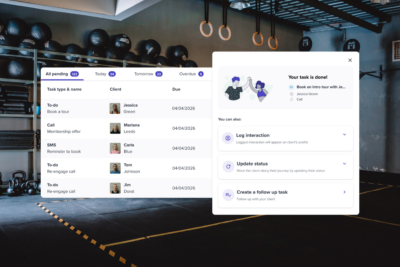
You don’t need a native Instagram integration to make this work. Tools like ABC Glofox help you handle what comes after the click:
- Collecting bookings or consult requests
- Sending confirmations and reminders
- Tracking where that client came from
Rather than relying on DMs or untracked links, ABC Glofox lets you create a clean process between content and conversion, whether that’s for a local trial or an online coaching start.
Free Resource: The Top 10 Barriers Slowing Your Fitness Business Growth
A 30-Day Instagram Action Plan for Fitness Businesses
Weeks 1–2: Fix the foundation
- Clarify Instagram’s single job in your business
- Update bio language to state who you serve and what happens next
- Clean up highlights so trials, schedules, and social proof or testimonials are easy to find
Weeks 3–4: Establish a repeatable rhythm
- Publish Reels that answer one question per post
- Use Stories daily as light proof and reminders, not content marathons
- Post carousels that organize information people want to save or share
- Review profile visits and link clicks weekly
After day 30:
- Keep the formats that drive action
- Cut anything that produces attention without movement
- Refine messaging based on what has converted so far
Check Out: 10 Fitness Studio Marketing Ideas to Win Your First 100 Members
FAQs
What are some tips for improving a fitness page on Instagram?
Start by clarifying the next action on your profile and in your posts, whether that is booking a trial, joining a class, or downloading a free resource. Show real proof, such as your coaches, members, and space. Design content to answer common questions, not to chase likes or trends.
How can I grow a fitness Instagram from scratch?
Focus on being genuinely useful to a very specific audience in a clear location or niche. Answer the questions people are already asking before they commit to a gym, class, or coach.
How can gyms use Instagram Stories for lead generation?
Stories work best as reminders and reassurance for people already considering you. Use them to show the environment, share quick wins, answer FAQs, and highlight trials or class schedules. Always include a clear link or reply prompt so viewers know exactly what to do next.
Do fitness businesses actually need Instagram to be successful?
In today’s market, yes, Instagram has become a default check-in point for most potential clients. It’s often the first place people look to see if you’re active, credible, and aligned with what they want. If you’re not there (or your page looks neglected), it creates doubt, and that doubt usually leads them elsewhere.
How do fitness businesses make money from Instagram?
If you’re selling coaching, sessions, or memberships, Instagram isn’t the store; it’s the front door. Monetization occurs when your system, behind the scenes, turns attention into action.
In Summary
Instagram is not a digital bulletin board. It is the first step in how people discover your gym or studio, decide if it is for them, and take action.
Instagram is no longer just a place to be seen; it’s also where decisions start. Most people won’t email, call, or visit your site without first checking your Instagram. And what they see there either moves them forward or sends them elsewhere.
If your content doesn’t lead to a clear booking step, you lose sign-ups. And if someone joins but there’s no system to keep them engaged, you lose retention. That’s not an algorithm problem, it’s a funnel one.
The goal isn’t more posts or more followers. It’s trials, bookings, and long-term members. To get there, your content system needs to do its job, and your software stack needs to pick up where Instagram leaves off.
A clean path looks like this: Reel or Story → trial link → booking → automated reminders → onboarding → retention.
Platforms like ABC Glofox help make that path work, from first tap to recurring revenue. You don’t need to guess what content is working; you can see what actually converts. Book a demo today to learn more!