
TL;DR: Attracting new gym members is harder and more expensive than it used to be. Here’s which gym marketing strategies are driving growth in 2026, and which ones are costing you time without results.
Gym owners are spending more on marketing and getting less predictable results.
Platforms are noisier, ad costs are up, and consumer behavior continues to change. Plus, most gym marketing advice is just a recycled list of channels with no indication of what’s worth your time right now.
Some gym marketing strategies are working better than ever. But some have lost their edge. The ones worth prioritizing do two things at once: bring in new members and help you keep the ones you already have.
In this article, we’ll cover what the data says about gym growth in 2026, what’s generating real results and what’s fading, and how to decide where to put your budget. Let’s go!
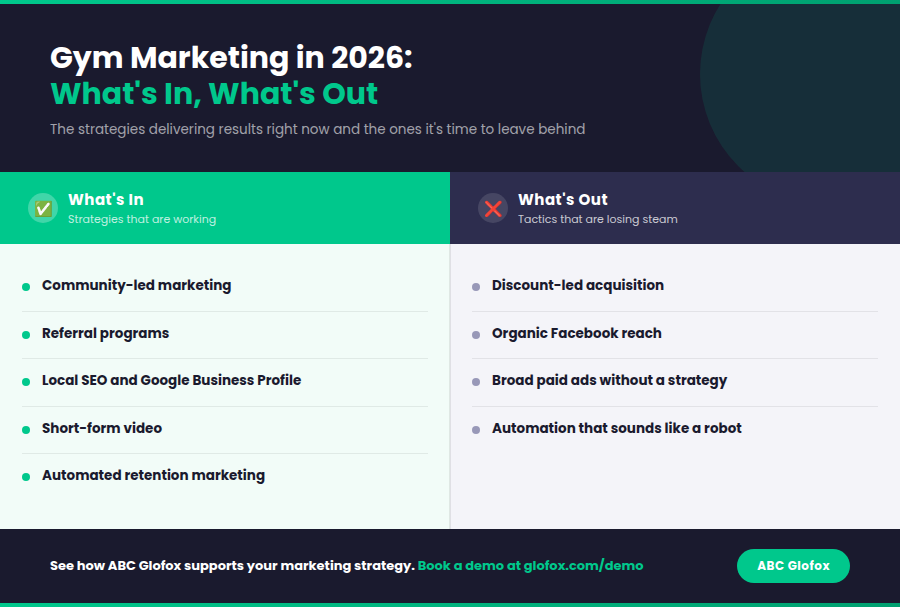
Table of Contents
The Gym Marketing Landscape Has Changed
The fitness industry is in transition. Understanding where the numbers are moving is the first step to smarter marketing.
What the numbers say about gym growth right now
According to our ABC Fitness Wellness Watch report, gym new joins grew just 1% last year, and studio new joins fell 3%. Unfortunately, these aren’t the growth curves most business owners were planning for.
At the same time, check-in activity at gyms was up 1% year-over-year. In fact, they were up 11% since 2021. This means the members who are going to the gym are showing up more than ever.
On the studio side, cancellations fell 6%. This suggests that experience-led studios focused on building community are holding their numbers steady where big-box gyms currently aren’t.
The average studio member spends $123.23 per month. Keeping a member for an additional six months is worth more than most campaigns designed to replace them. The implication for digital marketing for gyms? Retention isn’t the opposite of marketing. It IS marketing.
Why acquisition is getting more expensive
More gyms, more content, more ads… the cost of digital marketing for gyms (AKA getting in front of the right people at the right time) has risen across every major channel. And, with tighter privacy regulations and shorter tracking windows, leads need to be nurtured faster and more precisely than before.
This is why the best gym marketing strategies have compounding value: one effort today reduces churn, generates referrals, and builds a community that keeps growing.
📝 Read More: 2026 Fitness Trends: 4 Ways to Future-Proof Your Business
View this post on Instagram
What’s Working in Gym Marketing Right Now
Some of these gym promotion ideas will be familiar. What’s changed is how much they’re delivering relative to everything else.
Let’s take a look at 5 of the smartest gym marketing strategies right now:
#1 – Community-led marketing
Your people are the most under leveraged channel in fitness marketing.
According to our survey, 73% of respondents say being part of a fitness community helps them stay motivated. The top reason people join fitness communities is social interaction, cited by 57% of respondents.
Your gym’s culture is a marketing asset. When members feel they belong, they post about it on social media, tell their friends, and stay longer. Member ambassador programs, transformation challenges, and UGC (user-generated content) campaigns bring this asset to life without significant ad spend.
Make it easy for members to share their story, and your base will soon become your best acquisition channel.
🏆 Read More: 10 Fitness Studio Marketing Ideas to Win Your First 100 Members
#2 – Referral programs and why they convert
Data from across ABC Fitness’ customer base shows that referral programs converted at 41% in 2025, generating 92,000 sign-ups from 224,000 referrals. That rate significantly outperforms most cold paid advertising.
Referrals work because the lead already trusts the source. Referred members also tend to stay longer and spend more, because of the existing social connection.
A referral program that works has 3 components: simple mechanics, a reward both sides actually want, and CRM tracking so you can keep track of the revenue the program is generating.
📝 Read More: A Quick Guide to Creating an Effective Gym Referral Program
#3 – Local SEO and Google Business Profile
Someone searching “gym near me” is ready to act. What’s changed in gym marketing is how Google decides which businesses show up in the results.
Your Google Business Profile needs more attention than ever. Most gym owners just “set it and forget it.” But Google’s AI Overviews (the targeted suggestions at the top of Google when people search for answers) uses Profile data to generate results. Gyms who regularly update their profile with photos, respond to every review, and post on their Profile get more visibility.
The fundamentals still matter: consistent name, address, and phone number across listings, a steady flow of genuine reviews, and a profile that looks active. In 2026, profile completeness is the differentiator when it comes to digital marketing for gyms.
📝 Check Out: What Is AEO? A Simple Guide for Gyms and Fitness Studios in 2026
#4 – Short-form video and social content
Did you know? Instagram content is now indexed in Google search results! This means that a Reel about your most popular morning HIIT class can show up when someone searches for classes in your area.
Short-form video continues to reign supreme when it comes to digital marketing for gyms. That’s why fitness and nutrition dominates Instagram and TikTok.
This makes sense, given demographics shifts in the industry. Our survey shows that 47% of new big-box gym joins last year were Gen Z (ages 18-25). This is a cohort that decides where to work out based largely on Instagram and TikTok before they ever visit.
The most effective way to reach this demographic is member-generated content: authentic footage of real people getting real results. Anything overly polished or corporate will repel this segment.
#5 – Automated retention marketing
Keeping a member for 18 months delivers more value than acquiring two members who both leave in 90 days.
Key gym marketing strategies include: using behavior-triggered automations like milestone messages, check-in streak nudges, and win-back sequences. They keep members engaged without manual effort from your team.
At ABC Glofox, our automation tools are built to catch members before they disengage, with workflows triggered by the behaviors that predict churn rather than arbitrary time intervals.
📝 Read More: A Beginner’s Guide to Retention Email Marketing

What’s Not Working Anymore
#1 – Discount-led acquisition
Members who join because of a deal leave when the deal ends. The churn cycle that follows (replace, discount again, repeat) costs more than most operators realize.
Discount-heavy marketing also attracts price-sensitive prospects and repels higher-value ones.
Replace discounts with value-led offers: a free trial class, an intro challenge, a community event. These attract people who are a genuine fit.
📝 Read More: The Gym Sales Funnel: From Lead to Loyal Member
#2 – Organic Facebook reach
Organic reach for Facebook business pages has been declining for years. Thus, this form of digital marketing for gyms shouldn’t be your primary organic content channel in 2026.
Facebook still works for paid ads and local community groups. However, the time spent creating posts for a Facebook business page delivers a fraction of the return of the same effort on Instagram Reels, TikTok or YouTube shorts. Don’t overlook other platforms.
#3 – Broad paid advertising without a strategy
Running Meta or Google ads without a CRM is an expensive way to generate leads that don’t convert.
When it comes to digital marketing for gyms, here’s what actually performs:
- Tight targeting built around your best existing members
- Retargeting people who’ve already engaged
- Tracking that traces each sign-up back to the campaign that drove it
🔧 Read More: Save Time and Money: How ABC Glofox Replaces 5 Tools with One Platform
#4 – Automation that sounds like a robot
Just because 64% of Gen Z use AI-powered fitness apps, only 33% trust AI for their wellness needs. Automated messages that sound like AI don’t just fail to engage, they erode trust with the demographic representing nearly half of new gym joins.
Use automation for timing and triggering, but keep the message human. Personalized messages grounded in member behavior land better than “Hi [First Name]” on a one-size-fits-all template.

How to Evaluate What Deserves Your Marketing Budget
Every channel sounds compelling when someone’s selling it. Here’s some guidance for deciding what’s actually worth your time and money.
Four questions to ask about any gym marketing channel
Before adding a new gym marketing channel, run it through these questions:
- How much does it cost, in time and money, to succeed?
- Can I track whether it’s bringing in members and creating revenue?
- Does it help with acquisition, retention, or both?
- Does it reach the people who are likely to join and stay?
A channel that scores well on all four is worth your dollar. One that can’t be measured or only touches top-of-funnel leads should fall to a lower priority when your budget is tight.
Matching channels to your business type
The right channels for your gym promotion ideas depend on your role and your growth stage. Let’s examine gym marketing strategies that work based on your business type.
- Boutique studio owners: Community-led marketing, referral programs, short-form video, local SEO, and email tend to deliver strong returns. Your differentiation is your experience and your people. Channels that let this shine work harder for you.
- Gym owners and multi-location operators: CRM-connected paid ads, retention automations, and review generation scale more predictably with volume. As you add locations, tracking matters more than creativity.
- Managers responsible for member growth: Retention automations and referral mechanics are where your time is best spent. These are measurable, manageable, and compounding.
Try our CRM, ABC XLerate to track lead sources and connect your marketing activity to actual outcomes. With these tools, you can see clearly what’s converting and where to focus next.
💻 Read More: Everything You Need to Know About Fitness Marketing
“Having ABC Glofox helps us to see what our next move should be. It allows us to make strategic plans for the business and grow.”
– Wal Nunes, Studio Integral
FAQs: Gym Marketing Strategies and Channel Selection
How do I market my gym effectively in 2026?
Focus on channels that serve both acquisition and retention. Community-led marketing, referral programs, local SEO, and behavior-triggered email automation all deliver compounding value. (For a full breakdown, check out our guide to 20 Evergreen Marketing Strategies for Gyms.)
What are the 7 P’s of marketing for a gym?
- Product: Your experience and programming
- Price: Which shapes conversion and positioning
- Place: Location and digital presence
- Promotion: Your channel mix
- People: Your coaches and staff, often your most powerful marketing asset
- Process: How easily members can join and engage
- Physical Evidence: Your facility, branded app, and the social proof prospects encounter before they visit).
How should a gym allocate its marketing budget?
Prioritize channels you can measure. If you can’t track whether something is generating members, it’s difficult to justify increasing spend on it. For most operators, referral programs, local SEO, and retention automations deliver the highest return relative to cost.
How does member retention connect to gym marketing?
Every member you keep is one you don’t have to replace through paid acquisition. Retaining a member for an additional six months (at an average of $123.23/month for studio members) is worth more than most top-of-funnel campaigns. Retention marketing reduces your customer acquisition cost by multiplying the value of every member already in your gym.
Build a Gym Marketing Strategy That Works in 2026 With ABC Glofox
The gym marketing channels worth your investment are the ones that serve acquisition and retention at the same time. Community, referrals, local search, and smart automation all do both. Discount campaigns, untargeted ads, and organic Facebook posts mostly do neither.
What separates a marketing strategy from a wish list is measurement.
At ABC Glofox, our built-in CRM, lead source tracking, retention automations, and analytics connect your marketing activity to real outcomes. You can easily figure out what’s working and cut what isn’t to future-proof the business you worked so hard to build.
Book a free demo to see how ABC Glofox supports gym marketing that drives both growth and retention.