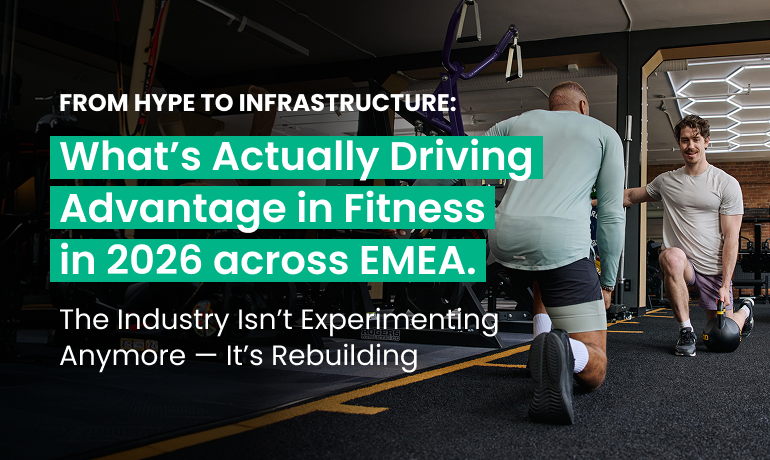
The Industry Isn’t Experimenting Anymore — It’s Rebuilding
For years, the fitness industry has talked about digital transformation as an add-on. That era is over.
What emerged from The HFA Show, the largest health and fitness operator event in North America — and what’s becoming increasingly clear ahead of FIBO — is that operators are no longer experimenting with AI. They’re rebuilding their operating models around it.
Not because it’s new. But because the economics of the industry now demand it.
Margins are under pressure. Labour remains constrained. Member expectations continue to rise. And perhaps most importantly, growth is no longer being driven by acquisition alone — it’s being won or lost on retention, efficiency, and experience.
AI is not solving a technology problem. It’s solving a structural one.
But there is good news – fitness remains a key part of people’s regular wellbeing and the connection between fitness and community is becoming stronger.
AI as Infrastructure: The Shift That Matters
SThe most important shift discussed at HFA wasn’t about tools, it was about mindset.
Currently, AI has been seen as a bolt-on capability — but at ABC Fitness, it is becoming core infrastructure. And that changes how it’s used.
AI is being used to leverage the insights and data in dashboards, helping operators are focusing on action that is personalized to the member with the right timing.
In principal, this is what we’ve always been trying to do, but at scale, this is only possible with AI. And now we’re seeing it applied across key areas that directly impact the P&L.es actually run: marketing, retention, referrals, lead conversion, trainer engagement, and member accountability.
1. Revenue: From Reactive Sales to Always-On Growth
AI is reshaping how revenue is generated — not just how it’s reported.
Operators are leveraging data and their tech stack to deploy:
- Conversational sales and retention agents
- AI-driven upsell and personal training recommendations
- Automated follow-ups and lead nurturing
- Leveraging data to make accurate predictions
How this drives efficiency:
It removes gaps in the sales process, ensures consistency, and scales outreach without increasing headcount.
Business impact:
Higher conversion, improved retention, and increased lifetime value — without proportional increases in staffing.
Caveat: Without data depth, AI remains surface-level. With it, it becomes transformative.ings to member communications, payments, reporting, and access.
💰 Read More: The ROI of Automation in Fitness Studios
2. Experience: Scaling Personalisation Without Scaling Headcount
Delivering a consistent, personalised experience has traditionally been limited by staff capacity.
AI removes that constraint.
Operators are using it to:
- Power knowledge agents for staff
- Deliver consistent, personalised member communications
- Help fill classes and manage capacity limits with personalized outreach and plans
- Support onboarding and ongoing engagement journeys
How this drives efficiency:
It standardises quality, reduces reliance on individual staff performance, and ensures every member receives timely engagement.
Business impact:
Stronger member satisfaction, deeper engagement, and improved retention outcomes.
The data already reinforces this direction: app-integrated gyms are achieving retention rates of ~72%, significantly outperforming industry averages.
3. Retention Engineering: Why Retention Has Become the Primary Growth Lever
The traditional growth model in fitness has relied heavily on acquisition — but that model is becoming increasingly fragile.
Globally, first-year retention sits at approximately 52%, meaning nearly half of new members leave within 12 months. At the same time, operators are being asked to do more with less — managing growing member bases, increasing revenue per location, and meeting rising expectations for personalised experiences.
The implication is clear: retention is no longer a downstream metric. It is a primary driver of growth — and increasingly, something operators can actively design and control.
AI is enabling a more proactive, structured approach to retention, particularly in the critical first 30 days:
- Identifying early signs of disengagement before churn risk escalates
- Triggering timely, proactive outreach based on member behavior
- Guiding members into consistent habits through personalised programming and nudges
- Increasing convenience through flexible scheduling and access, reducing friction to engage
How this drives efficiency:
It shifts retention from reactive intervention to proactive, automated workflows — reducing manual effort while ensuring consistent, timely engagement at scale.
The Top 10 Barriers
Slowing Your Fitness
Business Growth
Discover more Business impact:
Improved first-year retention, higher lifetime value, and more predictable revenue — without proportional increases in staffing or acquisition spend.
4. Payments: From Processing to Orchestration
One of the most underappreciated shifts in the industry is happening in payments. Payments are no longer just a back-office function — they are a core part of the member experience and a critical lever for revenue protection. With $14 billion in transactions flowing through ABC Fitness platforms annually, payments data is becoming one of the most powerful inputs for identifying risk, optimizing collections, and improving member experience at scale.
Leading operators are moving toward intelligent payment orchestration:
- Automating collections and failed payment recovery
- Embedding compliance (PCI, TCPA, CAN-SPAM) into workflows
- Expanding member self-service to reduce friction
How this drives efficiency:
It reduces manual workload, improves recovery rates, and eliminates avoidable revenue loss.
Business impact:
Stronger cash flow, lower operational burden, and improved member trust.
Where Operators Still Get It Wrong
Despite the momentum, there are still common pitfalls.
Treating AI as a tool, not infrastructure
Disconnected use cases fail to deliver meaningful impact.
Starting too big, too fast
The most effective strategies begin with small, measurable use cases and scale from there.
Ignoring governance
Without clear controls around data privacy, consent, and compliance, risk increases alongside capability.
Over-automating the experience
Efficiency should enhance human interaction — not remove it.
What Leading Operators Are Doing Differently
The operators pulling ahead share a common approach:
- They balance automation with human experience
- They start small, but scale fast once ROI is proven
- They prioritise high-impact use cases like retention, billing, and sales
- They build strong data foundations to enable accurate decision-making
- They embed AI into workflows, not alongside them
Most importantly, they are aligning AI directly to business outcomes — not experimentation.
The Bigger Shift Heading into FIBO
As the industry heads into FIBO, the conversation is changing.
It’s no longer about whether AI will play a role in fitness.
It’s about how deeply it will be embedded into the way operators run their businesses.
The leaders are no longer asking:
“How can we use AI?”
They’re asking:
“Where is inefficiency still costing us growth?”
And then applying AI to remove it.
The Takeaway
“Don’t use AI to do things better. Use AI to do better things.”
Paul LeBlanc, Former President, Southern New. Hampshire University
Because in the next phase of the fitness industry, competitive advantage won’t come from adopting technology.
It will come from redesigning the business around it.
Disclaimer: The data and statistics used in this blog are propriety to ABC Fitness
ABC Glofox is built to help fitness studios and gyms run more of the business from one connected platform, with the flexibility to support key partner integrations where needed. If you are comparing solutions, a live demo is the fastest way to see what is already built in, what is supported through the ecosystem, and how the platform can fit your specific operating model.
Book an ABC Glofox demo to see how the platform supports the full studio journey, from member management and bookings to engagement, payments, and business insights.